For the last couple of weeks, every time I've gone to look up something on FamilySearch I've been taken to the new site. And almost invariably, after getting the first result from the new site, I scroll down to the bottom of the screen and look for the old version.
Why is that?
The main reason I prefer the old version is that it permits me to download a GEDCOM file of what I find, which can save an awful lot of typing, if the record is one that I was actually looking for.
The second reason is that, for all its faults, the old version was easier to search than the newer one.
On the old one, you could enter a person's name, and the date of an event, which you could specify. If you specified "Birth/Christening" it would find people in the 1881 census of the UK if they were born at roughly the right time. You could narrow it to search in only one country, or in all countries.
The new FamilySearch is far vaguer, and asks for a beginning date and an ending date, without specifying the kind of event. This is too vague, and it's not clear what you should put in the dates - the person's lifespan? Or something narrower? If someone was 50 in the 1851 census, do you specify the dates as 1851, or 1800-1851? If you say 1851, won't you get all the wrong people -- not just people who were around 50 years old, but all people with that name, not matter what their age?
Another problem with it is that it seems to follow the currently fashionable web-design princible of making the screen as difficult to read as possible. Readability must be sacrificed to eyestrain. Use pale grey text on a white background, to make it easy to miss the fact that the text is there at all. FamilySearch is not the only site that has this problem. In one of my WordPress blogs, I'm always editing peoples comments when I want to reply to them. That is because the "Edit" option is legible, but the "Reply" option is only discernible when one peers very closely at the screen.
The advantage of the new FamilySearch is that you can specify not only a country, but a particular place, whether town or province, in the country. This makes it possible to narrow the search, and eliminate some less-likely results, or at least push them down the probability list. But the vagueness of the date/age question seems to undermine this advantage.
Another advantage of the new FamilySearch is that it covers a greater variety of records, but this is vitiated by the fact that there is less that you can do with them when you find them.
I'm all in favour of new and improved versions, but though this one is new, it isn't improved. For every useful new feature added, there is an old useful feature that has been taken away.
Thursday, February 03, 2011


Thursday, January 13, 2011
More on Posterous, Tumblr and Amplify
For a couple of months now I've been trying out Posterous and Tumblr,and was recently reminded that I had tried something on Amplify a year ago, but forgotten that I belonged to it, so I had another look at that too.
I can't say that I'm fully au fait with any of them yet, and I certainly haven't discovered how to use all their features. I'm quite unqualified to write a manual on how they should be used. So why am I writing about them here?
I'm writing this because I suspect that there are a lot of people like me who are not fundies about this stuff, and yet would like to be able to use it and know what it is good for.
I've found that some things are easier than others, and things that are easy in some programs are more difficult in others.
In general, I've found Tumblr is good for gathering, and Posterous for scattering.
I use Tumblr mainly as a kind of blog aggregator. It gather stuff from various blogs that I write, and it publishes a summary. I can grab interesting stuff from the web and put it on Tumblr, and it passes that on to Twitter as well. So I say to people, if you want to follow me, follow me on Tumblr rather than Twitter. You can see summaries of my various blog posts, and if any of them look interesting, you can click on them and see the whole thing. Tumblr acts like a published set of journal abstracts -- you can look through it to find which articles might be interesting without having to read the whole thing. To me that makes more sense than an RSS feed of full blog posts, which seems to me to be the surest way to information overload. Tumblr lets you see what's available and pick the stuff you want to read.
Posterous seems to work best the other way round. It lets you input by e-mail, and then disseminate widely from there. Its e-mail input seems to work better than Tumblr, and lets you include pictures, documents, and text in the message body. In Tumblr this is more difficult, but Tumblr picks up stuff from Posterous nicely, including documents (.pdf and several other formats).
I've been using Posterous mainly for family history, and it posts stuff to our family history blog on Wordpress with no problems, as well as passing it on to Tumblr.
Our former bishop sent me a document the other day, and asked me to put it on the web for him. It was called "The responsibility of Orthodoxy in 2011". Well, I put it on a static web page (here, if anyone is curious), but it's not really the kind of material that suits a static web page. I had no hesitation in recommending Posterous to him, as it would be ideal for his purpose. All he needs to do is to e-mail the document as an attachment in .pdf, .rtf or .doc format, with his own comments, and Posterous does the rest. And when he wants to write another document in 2012 or 2013, Posterous handles that too.
Posterous has other things that don't work too well, or at least not for me.
They've just introduced a group feature, and as an experiment I started one just for our family. It works more or less like the regular Posterous, except each member of the group may contribute and it can be a private or public group. Only problem is, I can't read it. It shows a list of posts, but when you try to open any of the posts to read them, nothing happens. There's just a big blank white square on the screen, like this:

I think something is supposed to appear in that blank white area, but it doesn't.
And the same thing happens when you try to grab something off the web to post on Posterous -- a blank white area appears on the screen and a little turning thingy that says "Loading", and that's it. You can go and make a cup of coffee, or a three-course meal, and when you come back it's still "loading". And the one on Amplify seems to have similar problems. But the one on Tumblr works OK, so I'll carry on using that.
Well that's it so far. Posterous is good at one to many. Tumblr is good at many to one. I'm not sure what Amplify is good for yet.
I can't say that I'm fully au fait with any of them yet, and I certainly haven't discovered how to use all their features. I'm quite unqualified to write a manual on how they should be used. So why am I writing about them here?
I'm writing this because I suspect that there are a lot of people like me who are not fundies about this stuff, and yet would like to be able to use it and know what it is good for.
I've found that some things are easier than others, and things that are easy in some programs are more difficult in others.
In general, I've found Tumblr is good for gathering, and Posterous for scattering.
I use Tumblr mainly as a kind of blog aggregator. It gather stuff from various blogs that I write, and it publishes a summary. I can grab interesting stuff from the web and put it on Tumblr, and it passes that on to Twitter as well. So I say to people, if you want to follow me, follow me on Tumblr rather than Twitter. You can see summaries of my various blog posts, and if any of them look interesting, you can click on them and see the whole thing. Tumblr acts like a published set of journal abstracts -- you can look through it to find which articles might be interesting without having to read the whole thing. To me that makes more sense than an RSS feed of full blog posts, which seems to me to be the surest way to information overload. Tumblr lets you see what's available and pick the stuff you want to read.
Posterous seems to work best the other way round. It lets you input by e-mail, and then disseminate widely from there. Its e-mail input seems to work better than Tumblr, and lets you include pictures, documents, and text in the message body. In Tumblr this is more difficult, but Tumblr picks up stuff from Posterous nicely, including documents (.pdf and several other formats).
I've been using Posterous mainly for family history, and it posts stuff to our family history blog on Wordpress with no problems, as well as passing it on to Tumblr.
Our former bishop sent me a document the other day, and asked me to put it on the web for him. It was called "The responsibility of Orthodoxy in 2011". Well, I put it on a static web page (here, if anyone is curious), but it's not really the kind of material that suits a static web page. I had no hesitation in recommending Posterous to him, as it would be ideal for his purpose. All he needs to do is to e-mail the document as an attachment in .pdf, .rtf or .doc format, with his own comments, and Posterous does the rest. And when he wants to write another document in 2012 or 2013, Posterous handles that too.
Posterous has other things that don't work too well, or at least not for me.
They've just introduced a group feature, and as an experiment I started one just for our family. It works more or less like the regular Posterous, except each member of the group may contribute and it can be a private or public group. Only problem is, I can't read it. It shows a list of posts, but when you try to open any of the posts to read them, nothing happens. There's just a big blank white square on the screen, like this:

I think something is supposed to appear in that blank white area, but it doesn't.
And the same thing happens when you try to grab something off the web to post on Posterous -- a blank white area appears on the screen and a little turning thingy that says "Loading", and that's it. You can go and make a cup of coffee, or a three-course meal, and when you come back it's still "loading". And the one on Amplify seems to have similar problems. But the one on Tumblr works OK, so I'll carry on using that.
Well that's it so far. Posterous is good at one to many. Tumblr is good at many to one. I'm not sure what Amplify is good for yet.
Tuesday, December 28, 2010
Post-Confucianism and colonialism
There has been quite a lot of discussion about post-colonialism (though I'm still not quite sure what that is), but it seems that Korean post-Confucianism is taking on elements of colonialism, as more and more Koreans adopt Western feminism, and reject the values of confucian society that stressed the importance of family and blood ties.
donga.com[English donga]:
Some Asian societies, however, have not yet adopted surnames, as we have seen in some Sri Lankan cricketers, who simply have one name.
donga.com[English donga]:
Heo La-geum, professor of women’s studies at Ewha, says she often sees students who do not use their surnames in her classes. “In certain cases, people used the surnames of both parents to protest the patriarchal family system, but some criticized that using the surname itself is jus sanguinis,” she said.
“Since Korean culture has been heavily influenced by the Confucian practice of stressing blood ties, some are trying not to use their surnames as part of a cultural campaign.”
Some Asian societies, however, have not yet adopted surnames, as we have seen in some Sri Lankan cricketers, who simply have one name.
Thursday, December 16, 2010
Genealogy Software Reviews
A rather useful web site I came across the other day is Genealogy Software Reviews.
It lists over 550 programs with about 700 reviews, and you can add your reviews of the programs you like best, or those you hate most, or anything in between.
So if you've heard of a program and would like to try it, come here to see what other users have had to say about it, and if you do try it, have your say as well.
It lists over 550 programs with about 700 reviews, and you can add your reviews of the programs you like best, or those you hate most, or anything in between.
So if you've heard of a program and would like to try it, come here to see what other users have had to say about it, and if you do try it, have your say as well.
Saturday, December 04, 2010
Find A Grave - Millions of Cemetery Records
About twenty years ago the Genealogical Society of South Africa had a cemetery documentation project, which I was involved in for a while. The moving spirit behind it was Peter Holden, who was concerned about the deterioration of gravestones, which because of weathering and vandalism were being lost, and their information along with them. There were many farm cemeteries and no one knew where they all were, so he wanted both the graves and cemeteries to be documented.
Martin Zoellner and I worked on a computer program to make it easy for people to enter information on graves and cemeteries, either on a laptop at the cemetery itself, or from notes at home, and these could all be submitted to a central database.
The scheme got bogged down in a debate on whether the documentation should be an index of names and dates only, or a full transcription of the inscriptions. I favoured the full transcription because it wouldn't entail a second trip to the cemetery to get the full inscription later, and by the time one made the second trip it could have deteriorated even more. Eventually I got bored with the debate and lost interest in the scheme, but I know quite a lot of gravestones were recorded, and put on the NAAIRS computer of the Archives. Peter Holden died, and I don't know what happened to it after that.
Now I've come across a scheme that seems to do what I had in mind -- record graves anywhere and everywhere, with volunteers contributing as much as they can.
Find A Grave - Millions of Cemetery Records:
I know there are several local schemes for recording cemeteries, and some of them are on the web. But with this you don't have to record entire cemeteries, you can just contribute a few graves you have recorded. Of, if you wish, you can contribute bulk transcriptions, and they provide a spreadsheet template that you can download to use for the transcriptions.
Perhaps South African genealogists could take over where Peter Holden left off, and indeed go back over some of the ground to record full transcriptions where only indexes were recorded the first time around. It is something that local genealogical societies could do as a project, or individuals can do in their spare time.
Martin Zoellner and I worked on a computer program to make it easy for people to enter information on graves and cemeteries, either on a laptop at the cemetery itself, or from notes at home, and these could all be submitted to a central database.
The scheme got bogged down in a debate on whether the documentation should be an index of names and dates only, or a full transcription of the inscriptions. I favoured the full transcription because it wouldn't entail a second trip to the cemetery to get the full inscription later, and by the time one made the second trip it could have deteriorated even more. Eventually I got bored with the debate and lost interest in the scheme, but I know quite a lot of gravestones were recorded, and put on the NAAIRS computer of the Archives. Peter Holden died, and I don't know what happened to it after that.
Now I've come across a scheme that seems to do what I had in mind -- record graves anywhere and everywhere, with volunteers contributing as much as they can.
Find A Grave - Millions of Cemetery Records:
Find Graves.
Find the graves of ancestors, create virtual memorials, add 'virtual flowers' and a note to a loved one's grave, etc.
I know there are several local schemes for recording cemeteries, and some of them are on the web. But with this you don't have to record entire cemeteries, you can just contribute a few graves you have recorded. Of, if you wish, you can contribute bulk transcriptions, and they provide a spreadsheet template that you can download to use for the transcriptions.
Perhaps South African genealogists could take over where Peter Holden left off, and indeed go back over some of the ground to record full transcriptions where only indexes were recorded the first time around. It is something that local genealogical societies could do as a project, or individuals can do in their spare time.
Why do online newspapers never tell you where they are?
This snippet appeared in The Spokesman-Review. OK, in this example there are enough contextual hints to tell you that the paper is probably published in the US state of Washington, possibly in a town called Kettle Falls, but why doesn't that information appear in the masthead or its electronic equivalent?
Jim Kershner’s This day in history - Spokesman.com - Dec. 3, 2010:
I was interested in the article because Growdon is one of the surnames I am interested in, but very often in such articles there aren't enough contextual hints to work out what place it is referring to.
And of course I'd like to know who Mrs E.B. Growdon was (if it was 100 years ago, she must be dead by now). And, knowing American customs, the "E.B." is probably her husband's initials and not her own. They may have given women votes, but their own names didn't come for another 70-80 years or so. So it probably doesn't refer to Mrs Eddy Beachler Growden of Alaska.
So I check my records. Yes, we have an E.B. Growdon. He was Edmund Blair Growden (1826-1850), but he was born and buried in Bedford County, Pennsylvania. But he also had a son, Edmund Blair Growden (Growdon and Growden spellings are interchangeable), born six months after his father's death, so he never saw his father and his father never saw him. He died in September 1926 and was buried at Colville, Stevens County, Washington, USA. So perhaps his wife was a candidate, or one of them.
One wife was Amanda H. McNeal, and the other was Mahallia H. Groom. Either of them could have been the Mrs E.B. Growdon referred to in the article. Or it could have been someone else altogether. Well, Jim Kershner, if you read this, it could answer your question, or at least give a hint. But I'm not registering with a Username and Password for a once-off comment in the Spokesman-Review of maybe some town in Washington USA, which I'll probably never have cause to read again.
Jim Kershner’s This day in history - Spokesman.com - Dec. 3, 2010:
From our archives, 100 years ago
Women’s suffrage was less than a month old in the state, but the effects were already far-reaching.
And Kettle Falls was apparently in the forefront.
“Kettle Falls is believed to be the first town in the state of Washington to name women as members of the city council,” said the Spokane Daily Chronicle.
Two women, identified only as Mrs. E.B. Growdon and Mrs. T.L. Savage, had been appointed the day before as members of the council.
I was interested in the article because Growdon is one of the surnames I am interested in, but very often in such articles there aren't enough contextual hints to work out what place it is referring to.
And of course I'd like to know who Mrs E.B. Growdon was (if it was 100 years ago, she must be dead by now). And, knowing American customs, the "E.B." is probably her husband's initials and not her own. They may have given women votes, but their own names didn't come for another 70-80 years or so. So it probably doesn't refer to Mrs Eddy Beachler Growden of Alaska.
So I check my records. Yes, we have an E.B. Growdon. He was Edmund Blair Growden (1826-1850), but he was born and buried in Bedford County, Pennsylvania. But he also had a son, Edmund Blair Growden (Growdon and Growden spellings are interchangeable), born six months after his father's death, so he never saw his father and his father never saw him. He died in September 1926 and was buried at Colville, Stevens County, Washington, USA. So perhaps his wife was a candidate, or one of them.
One wife was Amanda H. McNeal, and the other was Mahallia H. Groom. Either of them could have been the Mrs E.B. Growdon referred to in the article. Or it could have been someone else altogether. Well, Jim Kershner, if you read this, it could answer your question, or at least give a hint. But I'm not registering with a Username and Password for a once-off comment in the Spokesman-Review of maybe some town in Washington USA, which I'll probably never have cause to read again.
Wednesday, November 24, 2010
The speeding up of family history
Family history is speeding up, so that it is now hard to keep up.
We got started on this in 1975, a week after we were married. An old college friend of mine, Alan Cox (who was, sad to say, murdered in Pakistan a few years ago) came to visit us, and mentioned that he was involved with ancestor hunting, and I said I'd always wanted to get into that, and asked him how. So he said, "Have you got an aunt?" so we went off to visit my aunt Doreen Maxwell, whom I hadn't seen for 10 years, and she let us see her parents' (my grandparents') marriage certificate, and my grandfather's date of birth. Alan said that when he got back to England he'd send me the birth certificate, and after about three months it arrived.
That gave us his parents, and with the help of books from the Durban library (I found Gerald Hamilton-Edwards's In search of ancestry very helpful), I ordered my great grandparents' marriage certificate by post, and then there was another six-week wait for it to arrive. It was quite a leisurely pursuit. Each piece of information was absorbed and digested while waiting a few weeks for the next one to arrive. We began to do the same thing with other branches of the family too, but there was still a long wait.
Local South African records had to wait. I was banned to Durban, and the archives were in Pietermaritzburg and out of bounds. I did get special permission for a holiday in Cape Town and so we followed the bits we had got from Val's grandmother, and found a whole bunch of Deckers, Falkenbergs and Kochs on Val's side, and Growdons on mine, in the Anglican parish registers in Queenstown. We went on to Cape Town, looked in the archives, where we tied some of them together. On the way back the car broke down in East London, which meant a lengthened stay there (for which we had to get special police permission) and we hired a car and drove around East London visiting relative's we'd never known we had when we left home. One of the most interesting was Lil Falkenberg, who got quite interested herself, and contacted all her cousins and got stuff for us. Back home, it took us several months to digest that.
That was all 35 years ago.
There were no personal computers, no Internet (at least not in South Africa), and we were chasing up only a couple of dozen family members.
Now we have over 15000 in the family tree, and it keeps growing. This year we've discovered several new ancestors on "brick wall" lines that we were stuck on before. And with more genealogical records available on line than ever before, it's possible to chase up the descendants. And the descendants keep multiplying. The little kids that Lil Falkenberg listed for us have now grown up and have kids of their own.
Last night we got a phone call from someone in America who asked about a branch of the faily we hadn't looked at for years. They'd seen it on a web site. We looked at what we had on that branch and saw that all those cute little toddlers we had recorded are now in their 30s and 40s, and some of them have kids of their own. We'd tried writing to some, or looking them up in the phone book, but often they'd moved away. But now there is Google, and some of them have web sites or on Facebook or other social networking sites, and you can e-mail them and get a reply within a day, rather than waiting weeks or months as we did when we started. There's so much more to do, and the information comes in so much faster, so that both the volume and the speed are increasing exponentially.
I thought when I retired I'd have more time for family history. I'm beginning to wonder if I've got more family history than I've got time for.
We got started on this in 1975, a week after we were married. An old college friend of mine, Alan Cox (who was, sad to say, murdered in Pakistan a few years ago) came to visit us, and mentioned that he was involved with ancestor hunting, and I said I'd always wanted to get into that, and asked him how. So he said, "Have you got an aunt?" so we went off to visit my aunt Doreen Maxwell, whom I hadn't seen for 10 years, and she let us see her parents' (my grandparents') marriage certificate, and my grandfather's date of birth. Alan said that when he got back to England he'd send me the birth certificate, and after about three months it arrived.
That gave us his parents, and with the help of books from the Durban library (I found Gerald Hamilton-Edwards's In search of ancestry very helpful), I ordered my great grandparents' marriage certificate by post, and then there was another six-week wait for it to arrive. It was quite a leisurely pursuit. Each piece of information was absorbed and digested while waiting a few weeks for the next one to arrive. We began to do the same thing with other branches of the family too, but there was still a long wait.
Local South African records had to wait. I was banned to Durban, and the archives were in Pietermaritzburg and out of bounds. I did get special permission for a holiday in Cape Town and so we followed the bits we had got from Val's grandmother, and found a whole bunch of Deckers, Falkenbergs and Kochs on Val's side, and Growdons on mine, in the Anglican parish registers in Queenstown. We went on to Cape Town, looked in the archives, where we tied some of them together. On the way back the car broke down in East London, which meant a lengthened stay there (for which we had to get special police permission) and we hired a car and drove around East London visiting relative's we'd never known we had when we left home. One of the most interesting was Lil Falkenberg, who got quite interested herself, and contacted all her cousins and got stuff for us. Back home, it took us several months to digest that.
That was all 35 years ago.
There were no personal computers, no Internet (at least not in South Africa), and we were chasing up only a couple of dozen family members.
Now we have over 15000 in the family tree, and it keeps growing. This year we've discovered several new ancestors on "brick wall" lines that we were stuck on before. And with more genealogical records available on line than ever before, it's possible to chase up the descendants. And the descendants keep multiplying. The little kids that Lil Falkenberg listed for us have now grown up and have kids of their own.
Last night we got a phone call from someone in America who asked about a branch of the faily we hadn't looked at for years. They'd seen it on a web site. We looked at what we had on that branch and saw that all those cute little toddlers we had recorded are now in their 30s and 40s, and some of them have kids of their own. We'd tried writing to some, or looking them up in the phone book, but often they'd moved away. But now there is Google, and some of them have web sites or on Facebook or other social networking sites, and you can e-mail them and get a reply within a day, rather than waiting weeks or months as we did when we started. There's so much more to do, and the information comes in so much faster, so that both the volume and the speed are increasing exponentially.
I thought when I retired I'd have more time for family history. I'm beginning to wonder if I've got more family history than I've got time for.
Saturday, November 20, 2010
Trying out Tumblr and Posterous
I've been trying out Tumblr and Posterous.
You've probably never heard of them, but they are quick 'n dirty blog hosting sites that let you share stuff with a minimum of fuss and bother.
If you're toying with the idea of starting a family history blog, but don't want to get into all that computer nerd stuff, one of these may be just what you're looking for.
If you frequently e-mail family and friends to share photos, cartoons, urban legends, family news and photos, then try sending the stuff to Posterous or Tumblr instead. No fuss, no bother, and either of them will turn it into a nicely-formatted blog.
I've started using Tumblr for general stuff, and Posterous for family history stuff, just to see how well they work, and I invite you to have a look and see what you think, and perhaps start one of your own. It's as easy as sending an e-mail. You don't have to be a computer nerd to use them, though from what I can see it is mostly my computer nerd friends that have discovered them.
Anyway, if you'd like to look at mine they are at:
For general stuff there's Marginalia on Tumblr.
For family and family history stuff there's Hayes family updates on Posterous.
though there is quite a bit of overlap as I try them out with some of the same things.
I've noticed a few things.
Posterous handles photos a bit better than Tumblr.
If you e-mail a photo to posterous, it makes the subject line the heading, and the body of the e-mail the body of the post. Just make sure to type #ends where you want the text to end, otherwise it might include all sorts of unnecessary details.
Tumblr handles documents better than Posterous.
I posted a pedigree chart to both, and Posterous handles it via Scribd. It's OK, but the Tumblr one looked better on screen and was easier to read.
But check them out for yourself and make up your own mind.
I don't think either is a complete replacement for "proper" blogging sites like blogspot.com and wordpress.com, because they lack several features of those. For example, neither of them seem to support the widgets (or in Blogger-speak, gadgets) that you'll find in the right margin of this blog, with links to things like MyBlogLog, Webrings and the like. I find those useful for surfing particular kinds of blogs, like genealogy blogs, for example, so I'm not planning to abandon this blog, or my Wordpress one which deals more with our own family.
But for quick-fix family updates and sharing your research discoveries, family news and photos, Tumblr and Posterous are ideal.
You've probably never heard of them, but they are quick 'n dirty blog hosting sites that let you share stuff with a minimum of fuss and bother.
If you're toying with the idea of starting a family history blog, but don't want to get into all that computer nerd stuff, one of these may be just what you're looking for.
If you frequently e-mail family and friends to share photos, cartoons, urban legends, family news and photos, then try sending the stuff to Posterous or Tumblr instead. No fuss, no bother, and either of them will turn it into a nicely-formatted blog.
I've started using Tumblr for general stuff, and Posterous for family history stuff, just to see how well they work, and I invite you to have a look and see what you think, and perhaps start one of your own. It's as easy as sending an e-mail. You don't have to be a computer nerd to use them, though from what I can see it is mostly my computer nerd friends that have discovered them.
Anyway, if you'd like to look at mine they are at:
For general stuff there's Marginalia on Tumblr.
For family and family history stuff there's Hayes family updates on Posterous.
though there is quite a bit of overlap as I try them out with some of the same things.
I've noticed a few things.
Posterous handles photos a bit better than Tumblr.
If you e-mail a photo to posterous, it makes the subject line the heading, and the body of the e-mail the body of the post. Just make sure to type #ends where you want the text to end, otherwise it might include all sorts of unnecessary details.
Tumblr handles documents better than Posterous.
I posted a pedigree chart to both, and Posterous handles it via Scribd. It's OK, but the Tumblr one looked better on screen and was easier to read.
But check them out for yourself and make up your own mind.
I don't think either is a complete replacement for "proper" blogging sites like blogspot.com and wordpress.com, because they lack several features of those. For example, neither of them seem to support the widgets (or in Blogger-speak, gadgets) that you'll find in the right margin of this blog, with links to things like MyBlogLog, Webrings and the like. I find those useful for surfing particular kinds of blogs, like genealogy blogs, for example, so I'm not planning to abandon this blog, or my Wordpress one which deals more with our own family.
But for quick-fix family updates and sharing your research discoveries, family news and photos, Tumblr and Posterous are ideal.
Friday, November 19, 2010
Lost genealogy web sites
It's now a year since Yahoo! closed down Geocites, which was one of the very first social networking sites. It consisted of a series of themed virtual communities where people could build web sites based on particular themes. A lot of people put their family history on Geocities sites, and some of them died, and some forgot about their sites and no longer updated them. Yahoo! took over Geocities, ran it dowen, and then closed it, and some us were worried that a lot of the information there might be lost.
But some sites have archived at least some of what was on Geocities, so it isn't all lost. One of them is Reocities, which managed to salvage quite a lot. Another is Oocities, though ZoneAlarm flags Oocities as suspicious, I'm not sure why. Oocities has saved several family history sites that were on Geocities, including our own. Of course they will never be updated, but what was there has been preserved. And Reocities has done the same.
And there are some other possibilities for searching for lost web pages and other information: Your Growing Tree- Research Adventures & Thoughts:
So just when you thought all was lost, something may be found.
But some sites have archived at least some of what was on Geocities, so it isn't all lost. One of them is Reocities, which managed to salvage quite a lot. Another is Oocities, though ZoneAlarm flags Oocities as suspicious, I'm not sure why. Oocities has saved several family history sites that were on Geocities, including our own. Of course they will never be updated, but what was there has been preserved. And Reocities has done the same.
And there are some other possibilities for searching for lost web pages and other information: Your Growing Tree- Research Adventures & Thoughts:
I started using Archive.org in my job as a paralegal. It has archived versions of websites that I use in patent citations. The other side of Archive.org is that it archives almost anything...for free. I find live concerts from my favorite band here, and more importantly....books with info for my research. For example- If you look up 'History of Butler County' it brings up several books from the 18-1900's that are searchable and downloadable. These books have had a huge amount of information about the one family that I am researching.
So just when you thought all was lost, something may be found.
Thursday, November 11, 2010
Build A Better GEDCOM
A group has been formed to build a better GEDCOM (GEnealogy Data COMmunication). GEDCOM has been used for about 25 years or more to transfer data from one genealogy program to another, regardless of the native data storage format of the sending and receiving programs.
Build A Better GEDCOM - Eastman's Online Genealogy Newsletter:
They have started a wiki for discussion of the problems and the process, which seem a good way of doing things.
One of the things I think is important in this kind of exercise is not to overlook the old standard.
Whatever the limitations of the older GEDCOM formats, they worked.
Even if a new standard is developed, people keeping their data in older programs will not be able to export their data in the new format, and so may actually find it more difficult to exchange data with other genealogists if a new standard is developed. It might turn out, for example, that new programs would import data from older GEDCOM formats, but only export it in the new format, and some might not even use the old format at all. The purpose of GEDCOM is to facilitate data exchange, but one must be careful that it does not end up being counterproductive, and actually limiting data exchange. A limited but universal standard is better than a less limited but incompatible one.
I still use a program, Family History System (FHS), that uses two old forms of GEDCOM. One is the original GEDCOM, which no other program uses, and so FHS only uses it to export and import it to itself. It is the only one that exports and imports all the data to and from FHS. The other one is GEDCOM 2, used by PAF 2.x, which does not export all the data, but exports the main lineage-linked families and notes.
The oldest GEDCOM standard is not compatible with the newer ones. But compatibility is the main thing. It is better to be able to exchange some data than no data at all.
Build A Better GEDCOM - Eastman's Online Genealogy Newsletter:
Tuesday Nov 9, 2010. Alexandria, VA. A group of genealogists and programmers have established a workspace called Build A BetterGEDCOM for developing better data exchange standards to facilitate sharing between researchers using a variety of technology platforms, genealogy products and services.
'Genealogy software users are painfully aware that sharing data with other researchers is difficult since the existing GEDCOM (GENealogy Data COMmunication) file transfer script hasn't been updated in 14 years. In the meantime genealogists have incorporated tools with expanded capabilities reflecting changing technology,' says Russ Worthington, a genealogy software power user and popular genealogy lecturer.
They have started a wiki for discussion of the problems and the process, which seem a good way of doing things.
One of the things I think is important in this kind of exercise is not to overlook the old standard.
Whatever the limitations of the older GEDCOM formats, they worked.
Even if a new standard is developed, people keeping their data in older programs will not be able to export their data in the new format, and so may actually find it more difficult to exchange data with other genealogists if a new standard is developed. It might turn out, for example, that new programs would import data from older GEDCOM formats, but only export it in the new format, and some might not even use the old format at all. The purpose of GEDCOM is to facilitate data exchange, but one must be careful that it does not end up being counterproductive, and actually limiting data exchange. A limited but universal standard is better than a less limited but incompatible one.
I still use a program, Family History System (FHS), that uses two old forms of GEDCOM. One is the original GEDCOM, which no other program uses, and so FHS only uses it to export and import it to itself. It is the only one that exports and imports all the data to and from FHS. The other one is GEDCOM 2, used by PAF 2.x, which does not export all the data, but exports the main lineage-linked families and notes.
The oldest GEDCOM standard is not compatible with the newer ones. But compatibility is the main thing. It is better to be able to exchange some data than no data at all.
Woman given legal rights to remains of long-lost relative discovered on display in university
One of the things about family history is that you never know what you might find. Some of the skeletons in the closet can turn out to be quite literal.
Woman given legal rights to remains of long-lost relative discovered on display in university | The Sun |News:
Woman given legal rights to remains of long-lost relative discovered on display in university | The Sun |News:
A SHOCKED wife researching her family tree found she was related to a killer - still hanging from a NOOSE.
Gobsmacked Mary Halliwell was furious to discover the skeleton gruesomely displayed in a university cabinet 189 years on.
She launched a battle to be declared legal owner of the remains - and won.
Wednesday, November 10, 2010
Mohammed is now the most popular name for baby boys ahead of Jack and Harry
It seems that the most popular boy's name in Britain is now Mohammed, or variants thereof. I wonder how long that will last. For most of the 19th century the most popular boy's name was undoubtedly William, which made things confusing for genealogists, though towards the end of the 19th century there seemed to be more variety. Mohammed is now the most popular name for baby boys ahead of Jack and Harry | Mail Online:
I wonder about the popularity of Harry -- is that a result of the influence of Prince Harry, or Harry Potter, perhaps. And the popularity of Olivia for girls and Oliver for boys (Oliver would be top if you don't include the variant forms of Mohammed). Many of the top names on the list look like ones that might have been popular about 120 years ago. I had great aunts with names like Ruby. Anyone for Gladys or Agnes?
Another thought -- why do people refer to them as "baby" names. Are people likely to change them when they grow up? Forty years ago the most popular girl's name in the UK was Tracy/Tracey. But that "baby" name is now the name of a lot of middle-aged women. Tracy was quite popular in South Africa too. But I once looked through the baptism register of St Martin-in-the-Fields Anglican Church in Durban North, an upper middle-class suburb, and found the most popular girls names were Jacqueline and Michelle. I wonder if they have now given birth to a bunch of Olivias and Rubies.
The variety, or the lack of it, can make a difference to genealogy. One branch of our family lived in the inland parts of the Western Cape, and there was a sustom there of giving the eldest son the same name as his father, and then calling him "Boet" to distinguish him from his dad. And so you would have a hard time distingishing between people in a small village, where four cousins, born within a few years of each other, are all called Ockert Tobias. A friend of ours said he had an uncle whose first names were Nikolaas Johannes, and his father's had been that, and his grandfather's before him. But since they tended to get called by their initials, his cousin had been registered at birth as Enjay, which both continued the tradition and broke it.
Mohammed has become the most popular name for newborn boys in Britain.
It shot up from third the previous year, overtaking Jack, which had topped the list for the past 14 years but was relegated to third spot.
Olivia topped the list for little girls for the second year in a row, behind Ruby and Chloe.
A total of 7,549 newborns were given 12 variations of the Islamic prophet Mohammed’s name last year, such as Muhammad and Mohammad.
I wonder about the popularity of Harry -- is that a result of the influence of Prince Harry, or Harry Potter, perhaps. And the popularity of Olivia for girls and Oliver for boys (Oliver would be top if you don't include the variant forms of Mohammed). Many of the top names on the list look like ones that might have been popular about 120 years ago. I had great aunts with names like Ruby. Anyone for Gladys or Agnes?
Another thought -- why do people refer to them as "baby" names. Are people likely to change them when they grow up? Forty years ago the most popular girl's name in the UK was Tracy/Tracey. But that "baby" name is now the name of a lot of middle-aged women. Tracy was quite popular in South Africa too. But I once looked through the baptism register of St Martin-in-the-Fields Anglican Church in Durban North, an upper middle-class suburb, and found the most popular girls names were Jacqueline and Michelle. I wonder if they have now given birth to a bunch of Olivias and Rubies.
The variety, or the lack of it, can make a difference to genealogy. One branch of our family lived in the inland parts of the Western Cape, and there was a sustom there of giving the eldest son the same name as his father, and then calling him "Boet" to distinguish him from his dad. And so you would have a hard time distingishing between people in a small village, where four cousins, born within a few years of each other, are all called Ockert Tobias. A friend of ours said he had an uncle whose first names were Nikolaas Johannes, and his father's had been that, and his grandfather's before him. But since they tended to get called by their initials, his cousin had been registered at birth as Enjay, which both continued the tradition and broke it.
Tuesday, November 09, 2010
Tombstone Tuesday: Isle of Axholme
 A few years ago we travelled to the UK and visited churches in villages where ancestors lived, and in some places found family tombstones.
One of the places we visited was Crowle, in the Isle of Axholme, Lincolnshire, where my Vause family came from. We couldn't find any Vause tombstones in the churchyard, though there were a couple for the Bunyee family, and some members of the Vause family married Brunyees.
So we took some photos of Brunyee tombstones, but many of them were illegible, and most of the names didn't seem to connect with those in our family tree.

But for family history researchers with family members in the Isle of Axholme, Christmas has come early, as the Axholme Ancestry web site has just made 7000 tombstone photos available, and you can search them.
Wednesday, October 27, 2010
Bagot family forum
In the past few weeks I've had quite a lot of correspondence with people researching the Bagot family, and we've had a fruitful exchange of information.
As a result of this, and to facilitate further exchanges, we've set up a Bagot family forum on YahooGroups, and invite other Bagot researchers to join us there. The forum is intended mainly for people who are interested in or descended from Bagot families in north Lancashire and surrounding areas. In addition to the usual exchange of messages informing people about new discoveries, there are facilities for file exchange and creation of databases.
There are various spellings of the name. Bagot is the most common, but Bagott, Bagett, Bagat and other variations are quite common.
As a result of this, and to facilitate further exchanges, we've set up a Bagot family forum on YahooGroups, and invite other Bagot researchers to join us there. The forum is intended mainly for people who are interested in or descended from Bagot families in north Lancashire and surrounding areas. In addition to the usual exchange of messages informing people about new discoveries, there are facilities for file exchange and creation of databases.
There are various spellings of the name. Bagot is the most common, but Bagott, Bagett, Bagat and other variations are quite common.
Tuesday, October 12, 2010
Tombstone Tuesday: Tintagel churchyard
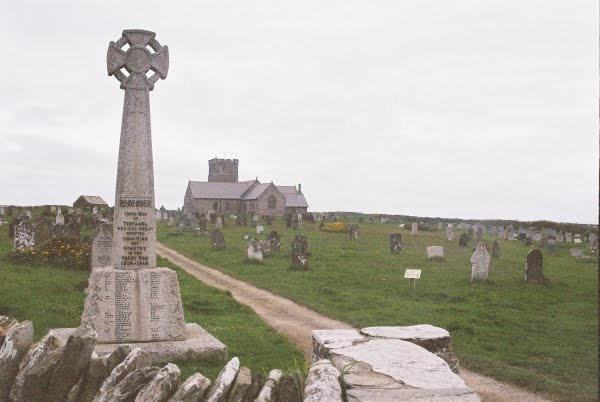 No members of our family in this picture of Tintagel churchyard in Cornwall. we had some how were born here, but none, apparently, who died here. The war memorial may be of interest to some.
Subscribe to:
Posts (Atom)