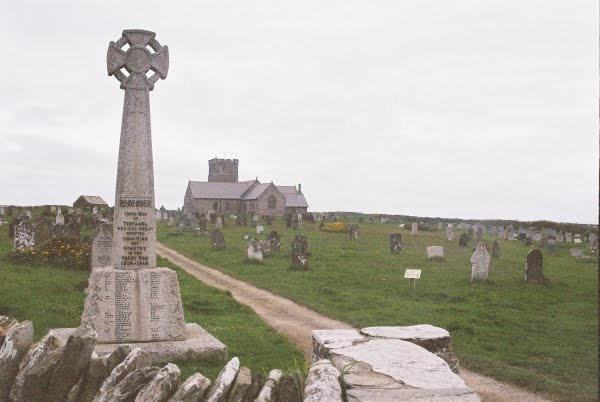
 No members of our family in this picture of Tintagel churchyard in Cornwall. we had some how were born here, but none, apparently, who died here. The war memorial may be of interest to some.
Tuesday, October 12, 2010
Tombstone Tuesday: Tintagel churchyard
No members of our family in this picture of Tintagel churchyard in Cornwall. we had some how were born here, but none, apparently, who died here. The war memorial may be of interest to some.


Saturday, September 25, 2010
Recording sources and documents
A few weeks ago I met Dennis Allsopp for lunch. Dennis lives in Australia, but visits South Africa occasionally on business, and one of his interests is developing the Genota family of genealogical note-taking software.
He had read my blog post on Keeping track of paper files | Hayes & Greene family history and decided to take up the challenge of developing a replacement for the Research Data Filer (RDF) program that used to be bundled with earlier versions of the Personal Ancestral File (PAF) lineage-linked program.
One of the problems with RDF is that it's a DOS program and it's a schlepp printing reports from DOS programs with Windows printers. But, as I noted in my earlier post, I've still found no better way of keeping track of paper files.
So if Dennis manages to develop a newer program that will do what RDF does, I'll be interested. I suppose the biggest challenge will be to get it to import the old RDF data.
Developing that might take quite a while, but in the mean time I played with Dennis's Genota Forms program and gave him a sample form template for entering information from South African deceased estate records. That could make it a hit with Southern African genealogists, as South Africa, Namibia and Zimbabwe use similar methods of handling deceased estates (called probate in other places).
He had read my blog post on Keeping track of paper files | Hayes & Greene family history and decided to take up the challenge of developing a replacement for the Research Data Filer (RDF) program that used to be bundled with earlier versions of the Personal Ancestral File (PAF) lineage-linked program.
One of the problems with RDF is that it's a DOS program and it's a schlepp printing reports from DOS programs with Windows printers. But, as I noted in my earlier post, I've still found no better way of keeping track of paper files.
So if Dennis manages to develop a newer program that will do what RDF does, I'll be interested. I suppose the biggest challenge will be to get it to import the old RDF data.
Developing that might take quite a while, but in the mean time I played with Dennis's Genota Forms program and gave him a sample form template for entering information from South African deceased estate records. That could make it a hit with Southern African genealogists, as South Africa, Namibia and Zimbabwe use similar methods of handling deceased estates (called probate in other places).
Thursday, September 09, 2010
South African genealogy and family history: Frequently-Asked Questions (FAQ)
If you are a newcomer to South African genealogy, you may have a lot of questions. Here are some answers to some of the most frequently asked questions:
WHERE'S THE BEST PLACE TO BEGIN?
If you're asking this on the Internet, presumably you have access to a web browser, and one of the best places to begin with South African genealogy is right here: http://home.global.co.za/~mercon/
WHERE CAN I FIND SOUTH AFRICAN CENSUS RECORDS?
The short answer is: You can't. South African census returns are routinely destroyed after statistical information has been abstracted, so South African genealogists don't use them.
WHAT DO SOUTH AFRICAN GENEALOGISTS USE THEN?
One of the best places to begin is the records of deceased estates. These usually have a Death Notice, which should (but sometimes doesn't) give you the names of the parents, spouse and children of the deceased, or if the deceased was unmarried, the names of brothers and sisters. They have the wills, if any (except in the Cape, where wills and estate accounts have been filed separately from death notices in the older estates), and the estate accounts. The older ones are in the archives and have
computer indexes, and you can search the indexes on the web here: http://www.national.archives.gov.za/naairs_content.htm, but be sure to read the introduction and explanatory text before searching.
WHERE CAN I FIND SOUTH AFRICAN SHIPPING LISTS?
First, they are not a good place to start looking. They are incomplete, and all over the place. If you want to know if some relative went to South Africa and died here, look in the deceased estates, not the shipping lists. In most cases, shipping lists
are a last resort, or a means of providing "filler" information to round out the family history. Secondly, if you do want to try shipping lists, you need to know where your ancestor came from, and roughly when. If the answer is Germany 1859, the shipping lists have been published (Werner Schmidt-Pretoria, Deutsche Auswanderung nach Sued-Afrika im 19 Jahrhundert). Some other shipping lists have also been published, but they are fragmentary.
If you are looking for ancestors who emigrated to Southern Africa in the period 1890-1925, one possible source is South Africa magazine. This was published in London. The Johannesburg Public Library and the National Library in Tshwane have incomplete runs.
You could try other libraries too. They published lists of passengers embarking at British ports for South Africa, and embarking at South African ports for the UK (and sometimes other places). South Africa magazine is a useful source, if you can find it, as it also has birth, marriage and death announcements, and other personal news, usually of the richer members of society.
Some of these have been transcribed by Ellen Stanton, and can be seen here: http://www.genealogyworld.net/ellen/shipping/index.html
Some other passenger lists and other useful stuff are available
at: http://www.genealogyworld.net/
WHERE CAN I FIND WILLS OR PROBATE RECORDS?
With the deceased estates. See:
http://www.national.archives.gov.za/naairs_content.htm
I did a search on the archives: what do the funny things like DEPOT and VOLUME mean?
See the warning above: Be sure to read the introduction and explanatory text before searching. If you didn't, go here now:
http://www.national.archives.gov.za/fields.htm
HOW DO I GET A BIRTH CERTIFICATE?
With some difficulty. First, to apply for one, you need to know the information you probably want to get from the certificate. That's Catch 22. Catches 1-21 are almost as bad. Birth certificates are expensive. They take a long time to get. The indexes are not open to the public so you can't ask someone else to look them up. For more information, and applications forms, see:
http://www.home-affairs.gov.za/
The good news is that the Church of Jesus Christ of Latter-Day Saints (LDS, Mormons) has microfilmed some of the registers, so that if you want the information in the register, as opposed to an official certificate, you can try there.
If you want to know what the LDS has, go to their web site:
http:// www.familysearch.com
or
http://www.familysearch.org ,
Click on LIBRARY, click on FAMILY LIBRARY HISTORY CATALOGUE, click on PLACE NAME enter South Africa Click on Civil Registration Click on HERE right at the bottom so
you have a printable copy.
HOW DO I GET A MARRIAGE CERTIFICATE?
Marriage certificates are of little use to genealogists in South Africa. They do not give the names and occupations of parents. They are as difficult to get as birth certificates.
For more information on getting marriage certificates see:
http://www.home-affairs.gov.za/
Your best chance of seeing a marriage certificate, however, is if the couple got divorced, and you find a copy in the divorce records. SOME divorce records are in the archives, and you can find them here:
http://www.national.archives.gov.za/naairs_content.htm
The archival references to divorces will sometimes speak of "illiquid cases" or "opposed applications", and sometimes there will be both. Make sure you order the right ones. They can be quite useful. Sometimes you can really get the dirt on your
ancestors from these things - private detectives' reports on how many times they committed adultery, where and with whom, for example. Also, names and ages of minor children and who got the custody.
If you still want a marriage certificate (or birth certificate), you need to apply to the Department of Home Affairs, Private Bag X114, Pretoria, 0001. Before they can issue a certificate, they usually want to know the kind of information you probably hope to get from the certificate. Marriages were registered nationally from 1923 to 1976, and after 1994. Between 1976 and 1994 some "homeland" marriages may have been registered separately. Before 1923 registrations were in the different provinces, and before 1910 in the different colonies. Before 1902 it was in the different republics and colonies. You still apply to the same place, but bear in mind that older registers are kept in the archives, and for a certificate to be written they have to be transferred from the archives to the Department of Home Affairs and then returned. This can take a long time.
Also check the information above under "Birth Certificates" on how to find out if any of the marriage registers have been filemed by the LDS Church.
Before about 1895 in many places marriages were only recorded in church registers.
The situation is a lot more complex than described above, and the complexities are things you can ask about on forums like the South Africa list, but the general description should give you some idea of the kind of questions that might be worth asking.
WHERE CAN I FIND CHURCH RECORDS?
With difficulty. There are well over 8000 separate religious denominations in South Africa, and many people change denominations 3 or more times during their lives. People move to a new town, and join a new denomination or religion, or become agnostics or atheists. The records of these denominations are all over the place too. Some of the older and larger denominations have centralised their records, but most have not. They are kept in local churches and can be damaged or destroyed by damp, acid paper or ink, insects, mice, fire or flood, or simply being tossed out in an over-zealous clean-up. Some of the smaller denominations keep very poor records. Forged marriage certificates are common, especially in rural areas. If you know what denomination your ancestors were, and where they were living, when children were born or they were married, you can ask some specific questions on the SA Genealogy list like "Where are the Wesleyan Methodist Registers for Colesberg in the period 1860-1880?"
But general requests for look ups in church registers without mentioning a particular denomination, time and place are unlikely to get a useful response.
WHERE CAN I FIND MILITARY RECORDS?
Department of Defence
DOCUMENTATION CENTRE
Private Bag X289
Pretoria
0001 South Africa
Tel 012-322-6350 ext 227
Fax 012-323-5613
The more info you can give the faster they can find details.
They have a card index for military personnel who served in WWI and WWII. These give the service number, which can be used to find fuller service records.
WHERE CAN I LOOK UP THE PHONE NUMBERS OF LIVING RELATIVES?
Turn your web browser to:
http://phonebook.yellowpages.co.za/
it's the on-line phone book.
WHAT IF MY FAMILY WERE IN OTHER PARTS OF AFRICA?
Try asking on the African Genealogy mailing list.
WHAT SHOULD I DO NEXT?
Go to: http://home.global.co.za/~mercon/sagen.htm
and follow the links!
--
This FAQ file is maintained by:
Steve Hayes
Web: http://hayesfam.bravehost.com/stevesig.htm
E-mail: hayesstw@gmail.com
Suggestions for additions or improvements are welcome.

WHERE'S THE BEST PLACE TO BEGIN?
If you're asking this on the Internet, presumably you have access to a web browser, and one of the best places to begin with South African genealogy is right here: http://home.global.co.za/~mercon/
WHERE CAN I FIND SOUTH AFRICAN CENSUS RECORDS?
The short answer is: You can't. South African census returns are routinely destroyed after statistical information has been abstracted, so South African genealogists don't use them.
WHAT DO SOUTH AFRICAN GENEALOGISTS USE THEN?
One of the best places to begin is the records of deceased estates. These usually have a Death Notice, which should (but sometimes doesn't) give you the names of the parents, spouse and children of the deceased, or if the deceased was unmarried, the names of brothers and sisters. They have the wills, if any (except in the Cape, where wills and estate accounts have been filed separately from death notices in the older estates), and the estate accounts. The older ones are in the archives and have
computer indexes, and you can search the indexes on the web here: http://www.national.archives.gov.za/naairs_content.htm, but be sure to read the introduction and explanatory text before searching.
WHERE CAN I FIND SOUTH AFRICAN SHIPPING LISTS?
First, they are not a good place to start looking. They are incomplete, and all over the place. If you want to know if some relative went to South Africa and died here, look in the deceased estates, not the shipping lists. In most cases, shipping lists
are a last resort, or a means of providing "filler" information to round out the family history. Secondly, if you do want to try shipping lists, you need to know where your ancestor came from, and roughly when. If the answer is Germany 1859, the shipping lists have been published (Werner Schmidt-Pretoria, Deutsche Auswanderung nach Sued-Afrika im 19 Jahrhundert). Some other shipping lists have also been published, but they are fragmentary.
If you are looking for ancestors who emigrated to Southern Africa in the period 1890-1925, one possible source is South Africa magazine. This was published in London. The Johannesburg Public Library and the National Library in Tshwane have incomplete runs.
You could try other libraries too. They published lists of passengers embarking at British ports for South Africa, and embarking at South African ports for the UK (and sometimes other places). South Africa magazine is a useful source, if you can find it, as it also has birth, marriage and death announcements, and other personal news, usually of the richer members of society.
Some of these have been transcribed by Ellen Stanton, and can be seen here: http://www.genealogyworld.net/ellen/shipping/index.html
Some other passenger lists and other useful stuff are available
at: http://www.genealogyworld.net/
WHERE CAN I FIND WILLS OR PROBATE RECORDS?
With the deceased estates. See:
http://www.national.archives.gov.za/naairs_content.htm
I did a search on the archives: what do the funny things like DEPOT and VOLUME mean?
See the warning above: Be sure to read the introduction and explanatory text before searching. If you didn't, go here now:
http://www.national.archives.gov.za/fields.htm
HOW DO I GET A BIRTH CERTIFICATE?
With some difficulty. First, to apply for one, you need to know the information you probably want to get from the certificate. That's Catch 22. Catches 1-21 are almost as bad. Birth certificates are expensive. They take a long time to get. The indexes are not open to the public so you can't ask someone else to look them up. For more information, and applications forms, see:
http://www.home-affairs.gov.za/
The good news is that the Church of Jesus Christ of Latter-Day Saints (LDS, Mormons) has microfilmed some of the registers, so that if you want the information in the register, as opposed to an official certificate, you can try there.
If you want to know what the LDS has, go to their web site:
http:// www.familysearch.com
or
http://www.familysearch.org ,
Click on LIBRARY, click on FAMILY LIBRARY HISTORY CATALOGUE, click on PLACE NAME enter South Africa Click on Civil Registration Click on HERE right at the bottom so
you have a printable copy.
HOW DO I GET A MARRIAGE CERTIFICATE?
Marriage certificates are of little use to genealogists in South Africa. They do not give the names and occupations of parents. They are as difficult to get as birth certificates.
For more information on getting marriage certificates see:
http://www.home-affairs.gov.za/
Your best chance of seeing a marriage certificate, however, is if the couple got divorced, and you find a copy in the divorce records. SOME divorce records are in the archives, and you can find them here:
http://www.national.archives.gov.za/naairs_content.htm
The archival references to divorces will sometimes speak of "illiquid cases" or "opposed applications", and sometimes there will be both. Make sure you order the right ones. They can be quite useful. Sometimes you can really get the dirt on your
ancestors from these things - private detectives' reports on how many times they committed adultery, where and with whom, for example. Also, names and ages of minor children and who got the custody.
If you still want a marriage certificate (or birth certificate), you need to apply to the Department of Home Affairs, Private Bag X114, Pretoria, 0001. Before they can issue a certificate, they usually want to know the kind of information you probably hope to get from the certificate. Marriages were registered nationally from 1923 to 1976, and after 1994. Between 1976 and 1994 some "homeland" marriages may have been registered separately. Before 1923 registrations were in the different provinces, and before 1910 in the different colonies. Before 1902 it was in the different republics and colonies. You still apply to the same place, but bear in mind that older registers are kept in the archives, and for a certificate to be written they have to be transferred from the archives to the Department of Home Affairs and then returned. This can take a long time.
Also check the information above under "Birth Certificates" on how to find out if any of the marriage registers have been filemed by the LDS Church.
Before about 1895 in many places marriages were only recorded in church registers.
The situation is a lot more complex than described above, and the complexities are things you can ask about on forums like the South Africa list, but the general description should give you some idea of the kind of questions that might be worth asking.
WHERE CAN I FIND CHURCH RECORDS?
With difficulty. There are well over 8000 separate religious denominations in South Africa, and many people change denominations 3 or more times during their lives. People move to a new town, and join a new denomination or religion, or become agnostics or atheists. The records of these denominations are all over the place too. Some of the older and larger denominations have centralised their records, but most have not. They are kept in local churches and can be damaged or destroyed by damp, acid paper or ink, insects, mice, fire or flood, or simply being tossed out in an over-zealous clean-up. Some of the smaller denominations keep very poor records. Forged marriage certificates are common, especially in rural areas. If you know what denomination your ancestors were, and where they were living, when children were born or they were married, you can ask some specific questions on the SA Genealogy list like "Where are the Wesleyan Methodist Registers for Colesberg in the period 1860-1880?"
But general requests for look ups in church registers without mentioning a particular denomination, time and place are unlikely to get a useful response.
WHERE CAN I FIND MILITARY RECORDS?
Department of Defence
DOCUMENTATION CENTRE
Private Bag X289
Pretoria
0001 South Africa
Tel 012-322-6350 ext 227
Fax 012-323-5613
The more info you can give the faster they can find details.
They have a card index for military personnel who served in WWI and WWII. These give the service number, which can be used to find fuller service records.
WHERE CAN I LOOK UP THE PHONE NUMBERS OF LIVING RELATIVES?
Turn your web browser to:
http://phonebook.yellowpages.co.za/
it's the on-line phone book.
WHAT IF MY FAMILY WERE IN OTHER PARTS OF AFRICA?
Try asking on the African Genealogy mailing list.
WHAT SHOULD I DO NEXT?
Go to: http://home.global.co.za/~mercon/sagen.htm
and follow the links!
--
This FAQ file is maintained by:
Steve Hayes
Web: http://hayesfam.bravehost.com/stevesig.htm
E-mail: hayesstw@gmail.com
Suggestions for additions or improvements are welcome.
Monday, September 06, 2010
America Before Pearl Harbor - Early Kodachrome Images
Family and social historians might find some of these old photos interesting, even if you don't live in America. Daily Kos: America Before Pearl Harbor - Early Kodachrome Images:
When I was at school we used to have a lot of old National Geographic magazines, going back to the 1920s. I think they were from an old collection donated by one of the parents. They had lots of colour photos from all over the world, but in those days relatively few were Kodachromes.
Kodachrome (which I believe has just ceased production after more than 70 years) was a subtractive process film, and in developing (which could only be done by Kodak) the metallic silver was replaced by colour dyes. This made it practical for small format cameras (called miniature cameras in those days), like 35 mm.
Most of the pictures in the old magazines seemed to be taken on Dufaycolor, which was an additive process film (and thus more like digital cameras today). It had red, green and blue dyes pre-printed on the film base in a pattern of blue and green squares and red lines, with the silver emulsion put on after that. The film went in the camera backwards, with the emulsiion facing away from the lens, and when developed, the silver went according to the red, green and blue filters it was exposed to. So when projected, the colour was reproduced. It worked fine on large format film, but on small format the pattern of lines and dots was noticable, and subtractive films like Kodachrome won in the miniature camera market.
But I saw Dufaycolor film advertised in a photographic magazine, and ordered some from England when I was still at school to try it out. The colour seemed much more accurate, but it only let through a third of the light of subtractive films, so when projected the slides looked rather dim. But for reproduction in magazines like the National Geographic it worked fine.
Earlier colour photos for reproduction in magazines were made by three-colour separation
s negatives, and their colour is far more accurate today than the faded dyes of subtractive film like Kodachrome. For more on this see here, with some fascinating photos from an even earlier period -- Russia before the First World War.
When we think of America during the Great Depression, we often picture it in shades of grey. It was a grim era and nearly all of the photographs we see are in black and white.
When I was at school we used to have a lot of old National Geographic magazines, going back to the 1920s. I think they were from an old collection donated by one of the parents. They had lots of colour photos from all over the world, but in those days relatively few were Kodachromes.
Kodachrome (which I believe has just ceased production after more than 70 years) was a subtractive process film, and in developing (which could only be done by Kodak) the metallic silver was replaced by colour dyes. This made it practical for small format cameras (called miniature cameras in those days), like 35 mm.
Most of the pictures in the old magazines seemed to be taken on Dufaycolor, which was an additive process film (and thus more like digital cameras today). It had red, green and blue dyes pre-printed on the film base in a pattern of blue and green squares and red lines, with the silver emulsion put on after that. The film went in the camera backwards, with the emulsiion facing away from the lens, and when developed, the silver went according to the red, green and blue filters it was exposed to. So when projected, the colour was reproduced. It worked fine on large format film, but on small format the pattern of lines and dots was noticable, and subtractive films like Kodachrome won in the miniature camera market.
But I saw Dufaycolor film advertised in a photographic magazine, and ordered some from England when I was still at school to try it out. The colour seemed much more accurate, but it only let through a third of the light of subtractive films, so when projected the slides looked rather dim. But for reproduction in magazines like the National Geographic it worked fine.
Earlier colour photos for reproduction in magazines were made by three-colour separation
s negatives, and their colour is far more accurate today than the faded dyes of subtractive film like Kodachrome. For more on this see here, with some fascinating photos from an even earlier period -- Russia before the First World War.
Saturday, September 04, 2010
Index of newspaper transcriptions
Sue McKay transcribed a lot of newspaper material replating to Southern Africa, which can be searched at the sGSSA site here. Now Anton Dil had provided a list of some of the names recroded there, which can be useful so you can know what to search for.
Zambia & Rhodesia Genealogy leads...: A-G Index to Sue Mackay's postings:
Thanks to Sue and Anton for providing this service to genealogists.
Zambia & Rhodesia Genealogy leads...: A-G Index to Sue Mackay's postings:
We are all indebted to Sue Mackay for her tireless transcribing of newspapers at Kew. I am trying to do my bit by providing a kind of an index to these pages. You can search the EGGSA pages I'm using here, but to use the search engine you have to guess at the name you're looking for. As we all know, names are often not what you imagine they will be - spellings change and there are typos or misspellings. Algorithms like Soundex only go so far to remedying this.
Thanks to Sue and Anton for providing this service to genealogists.
Connected Histories: Sources for Building British History, 1500-1900 | Institute of Historical Research
This looks as though it will be a useful resource once it gets going.
Connected Histories: Sources for Building British History, 1500-1900 | Institute of Historical Research:
The article goes on to say
Connected Histories: Sources for Building British History, 1500-1900 | Institute of Historical Research:
Early modern and nineteenth-century Britain is one of the times and places in history for which the largest number of digital sources is available. These have been created by universities, archives and commercial providers, and are accessed by tens of thousands of individuals each day. But many are under-exploited, and researchers are hampered in the way they use these materials by their distributed nature and the variable forms of tagging and structure present in each resource. Connected Histories provides the next stage in meeting historians’ needs by addressing the requirement to access historical resources in a single, consistent way; and in a manner that moves beyond simple keyword searching to a forensic and semantically-driven approach.
The article goes on to say
Using metadata and other available background information, the project will create a search facility that adapts to each resource (depending on whether and how the data is tagged, and on the text structure) to allow searching across the full range of chosen sources for names, places, and dates, as well as keywords and phrases. Background information about the search results will be delivered to the end user, and a facility to save and export search results for further analysis will also be provided. An online collaborative workspace will allow users to document connections between sources. The search facility will be expandable as new digital resources become available.
Thursday, September 02, 2010
A fresh start for this blog
I'm revamping this old family history blog, which has been dormant for a couple of years, and turning it into a general family history and genealogy blog. Our personal family history research will still mostly be on our other blog, which is on WordPress, which is better for things like posting family photos.
This blog will be for more general posts on family and local history and genealogy. News, information about resources, family history software, or background interest about places of interest, and especially the areas we are interested in -- southern Africa, the UK, Germany, Australia, New Zealand and Canada. The blogroll will reflect this, though I'll also be happy to link to any halfway decent genealogy blog that displays the "Recent Viewers" widget from MyBlogLog and/or BlogCatalog.
This blog will be for more general posts on family and local history and genealogy. News, information about resources, family history software, or background interest about places of interest, and especially the areas we are interested in -- southern Africa, the UK, Germany, Australia, New Zealand and Canada. The blogroll will reflect this, though I'll also be happy to link to any halfway decent genealogy blog that displays the "Recent Viewers" widget from MyBlogLog and/or BlogCatalog.
Reviving this blog
I've been thinking of reviving this blog.
I stopped adding to it about two years ago when Google were making all kinds of changes to the Blogger software, and there were more and more bugs in it. Like a lot of other bloggers, I moved this blog to WordPress, which seemed more stable.
Now the Blogger software is much improved, and for some purposes has some advantages over WordPress, and so it might be worth reviving.
But our main family history blog is still Hayes & Greene family history, so please check that as well.
I stopped adding to it about two years ago when Google were making all kinds of changes to the Blogger software, and there were more and more bugs in it. Like a lot of other bloggers, I moved this blog to WordPress, which seemed more stable.
Now the Blogger software is much improved, and for some purposes has some advantages over WordPress, and so it might be worth reviving.
But our main family history blog is still Hayes & Greene family history, so please check that as well.
Sunday, May 11, 2008
This blog has a new home
This blog has a new home at http://hayesgreene.wordpress.com/.
I have moved the older entries over to there, but the comments entered on the Haloscan comment utility may not have been moved.
I had to move it because every time I tried to read the blog here, I got a "403 forbidden" message, so I could not read either the entries or the comments.
I hope that the new system, called WordPress, proves more reliable than this one.
See you there.
I have moved the older entries over to there, but the comments entered on the Haloscan comment utility may not have been moved.
I had to move it because every time I tried to read the blog here, I got a "403 forbidden" message, so I could not read either the entries or the comments.
I hope that the new system, called WordPress, proves more reliable than this one.
See you there.
Saturday, May 10, 2008
Problem with this blog
All of a sudden, I can no longer read this blog.
It seems that I can add stuff to it, but there is a bug so that I can't read it. It seems that there is a problem with the Blogger software, run by Google.
I can still post stuff, but I can't read what I've posted, which means I also can't read any comments or responses.
If you want to respond to this message, please do so on my WordPress blog, which runs on different, and apparently more reliable software.
If the problem is not fixed soon, I will try to move this blog over to WordPress, but until then, if you are interested in our family history, please try our family history wiki pages at http://hayesgreene.wikispaces.com -- if you join there you can add and edit the family history, leave messages and queries and more.
It seems that I can add stuff to it, but there is a bug so that I can't read it. It seems that there is a problem with the Blogger software, run by Google.
I can still post stuff, but I can't read what I've posted, which means I also can't read any comments or responses.
If you want to respond to this message, please do so on my WordPress blog, which runs on different, and apparently more reliable software.
If the problem is not fixed soon, I will try to move this blog over to WordPress, but until then, if you are interested in our family history, please try our family history wiki pages at http://hayesgreene.wikispaces.com -- if you join there you can add and edit the family history, leave messages and queries and more.
Wednesday, May 07, 2008
Family WikiSpaces
You may have heard of Wikipedia, the free encyclopedia that anyone can edit, which is one of the most useful sources of information on the Internet.
Now we have started a family history Wiki on Wikispaces, and we invite all members of the family to have a look at it and join it.
What a blog is not so good for is things like anecdotes by and ancestors, biographies, research problems and dead-ends and so on. Updating biographical information on a two-year-old blog post is not much use, because few people will know that it has been updated, and so few will read it. But in a Wiki such information can be updated and added to as more information is found, and it can be found much more easily.
So, if you are related, go and look at the HayesGreene Wikispace, and think of stuff you can add. There's not much there yet, but there will soon be if we all get working on it.
Now we have started a family history Wiki on Wikispaces, and we invite all members of the family to have a look at it and join it.
The Hayes and Green family history space
This WikiSpace, called "hayesgreene" is for members of the Hayes, Greene and related families to post family news, history and anecdotes, and to make contact with other members of the family, and learn about the family history.Who is it for?
It's for any members of our families, that is, anyone who is related to us in any way. That means, in the first place, anyone descended from any of our ancestors -- uncles, aunts and cousins. That includes 1st cousins, 2nd cousins, up to and beyond 15th cousins seven times removed, and their spouses, parents of spouses and children of spouses.Who are we?
We are Steve and Val Hayes, and we live in Pretoria, Tshwane, Gauteng, South Africa. You can find out more about who we are on our family web pages, and also on our blog (which you're reading now!)How do I participate?
You participate by clicking on "join this space", which you will find somewhere on the left (not here, but in the WikiSpace page). If you are already a member of WikiSpaces, your application will be sent to us. If you are not already a member of WikiSpaces you will be invited to join (and then you can create your own WikiSpaces as well). When we receive your application, we will check to see whether you are related to us in any way, and if you are, your application will be approved and you will be able to add to and edit the information on these pages. But even if you are not related, you can still read the pages.How does this compare with a blog?
A blog is for changing information that quickly gets out of date. While you can find old blog posts, you have to search for them, and they are not always easy to find. A family history blog can be good as a record of new information found, meetings with family members, reports of family reunions and so on.What a blog is not so good for is things like anecdotes by and ancestors, biographies, research problems and dead-ends and so on. Updating biographical information on a two-year-old blog post is not much use, because few people will know that it has been updated, and so few will read it. But in a Wiki such information can be updated and added to as more information is found, and it can be found much more easily.
So, if you are related, go and look at the HayesGreene Wikispace, and think of stuff you can add. There's not much there yet, but there will soon be if we all get working on it.
Thursday, April 03, 2008
Josh Growden sets under 15 high jump record
I'm not sure which branch of the Growden family Josh Growden belongs to, but his record is worth recording. But he is a pupil at Clare High School, South Australia.
 clipped from www.diigo.com clipped from www.diigo.com
Under 15 Male Winner - Josh Growden.
|


Thursday, March 06, 2008
Bridget Hayes -graduation
Our daughter Bridget graduated yesterday at Athens University as a Master of Theology (I think).
Pictures here (the pictures are on Facebook, and you have to be logged in to see them).
Pictures here (the pictures are on Facebook, and you have to be logged in to see them).
Saturday, March 01, 2008
Hailee Growden in volleyball team
As I've said before, I don't know if any how Hailee Growden is related, burt here's a snippet of news anyway.
 clipped from www.herald-mail.com clipped from www.herald-mail.comThe Hagerstown Community College volleyball team underwent a changing of the guard Thursday at the HCC athletic complex.
|

Thursday, February 28, 2008
Simon's birthday
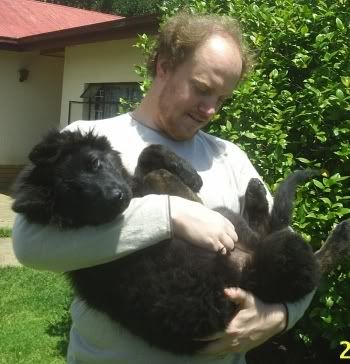 It is our son Simon's 30th birthday today, and to celebrate he didn't go to work.
Here he is with our puppy Fluffy Lumpkin, three and a half months old.
Subscribe to:
Posts (Atom)