Showing posts with label family history. Show all posts

Thursday, February 23, 2023

Farewell again to FamilySearch

Update

I was going to update this with the good news that FamilySearch had once again made their pages accessible, and that for the last few weeks I have been able to work with their site, and was going to rejoin the Facebook groups for FamilySearch users that I had had to leave, but today I found that I was locked out completely. Has anyone else had messages like these?

Access Denied
Error 15
I wonder what Error 15 is?

Earlier FamilySearch made their "new discovery page" compulsory, but it didn't work on my computer, so that cut down drastically on my family history research. Then I discovered that they had fixed it, so I continued working with it. But now I seem to be locked out completely.

Thanks to FamilySearch I was able to add some 30000 people to my family tree in the last 3-4 years, and make considerable contributions to the FamilySearch collaborative family tree as a result, but that has come to an end now that my access has been blocked.

Anyway, thanks to all the people who contributed to the FamilySearch Family Tree, and who helped by indexing source documents. It was good fun while it lasted.

Thursday, August 25, 2022

FamilySearch Place Names Chaos redux

Yet another example of the way in which FamilySearch is gradually destroying the records it has taken decades to collect. This is the third post in a row on this blog showing how FamilySearch is mangling place names in its records with its faulty algorithms. 


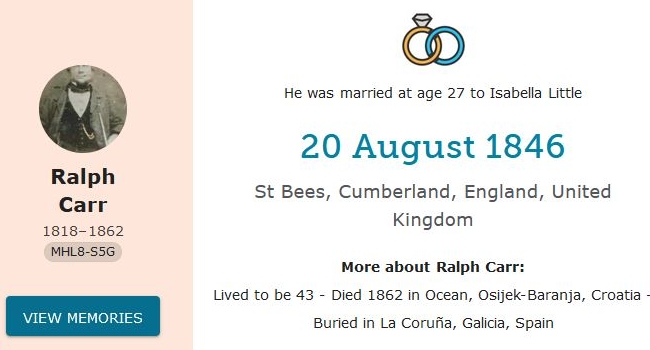
 Ralph Carr was my wife Val's great-great grandfather. He was a mariner, and died at sea. He was indeed buried at La Coruña, Galicia, Spain, because that happened to be the nearest port, but Croatia is quite a long way from Spain.

FamilySearch's algorithm seems to have translated "At Sea" to "Ocean", and then identified it with a place in Croatia.

It really is high time that the people at FamilySearch recognised that their algorithm is faulty, and stopped it moving people from town to town, from country to country, and even, in some cases, from continent to continent.


Tuesday, February 15, 2022

FamilySearch Place Names Chaos

A few months ago I posted an article about FamilySearch's "standardized place names" introducing errors (see FamilySearch Introducing Errors) but not only does nothing seem to have been done to fix the errors, but they seem to be getting worse. 

I am not talking here about errors in indexing. There are many indexing errors, some of which give rise to place name errors, especially when the original document is not available to correct it. 

The errors I am talking about here are not indexing errors but algorithmic errors, when the place name in the index is correct, or almost correct, and FamilySearch's algorithm changes it to something wrong. 

Also, FamilySearch flags many correct place names as wrong,  with warnings like !Missing Standardized Death Place, which encourage users to change a correct place name to a wrong one.

These errors can destroy the hard work of indexers, and that of family historians who have contributed to FamilySearch Family Tree. These algorithms should never have been let loose on the database before being tested to avoid such errors. 


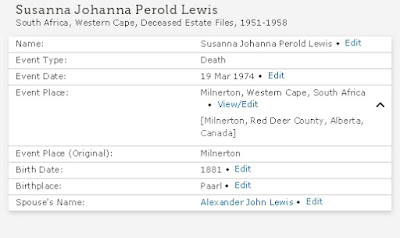
 This record, when attached to Family Tree, inserted the place name "Milnerton, Red Deer County, Alberta, Canada", which was altogether wrong. The error was not on the part of the indexer, nor on the part of the person who attached it to a record. The error was in the algorithm, which shifted the event not only to another country, but to a different continent. I copied this event to my RootsMagic database, and corrected the place to "Milnerton, Cape Province, South Africa" (which was more correct for the time of the event) and then copied it back to FamilySearch. But many people might just accept it, and copy the wrong place to their own family tree, and simply think that the family must have emigrated from South Africa to Canada. 

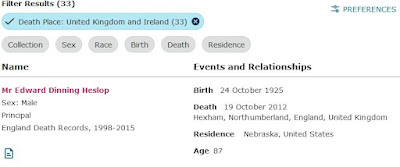
Here is another example:

In this case, it seems that large numbers of people who lived in Nebraska, USA, migrated to Northumberland, England, to die. The one shown above is just one example of many. 

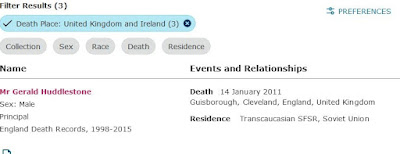
People in Trans-Caucasia, on the other hand, seemed to prefer to die in Cleveland, UK in the town of Guisborough:

These errors seem to be multiplying rapidly, and the longer the faulty algorithms stay in place, the more degraded the FamilySearch database will become.


Saturday, September 05, 2020

A shirt-tail cousin, and other relationship terms

About 45 years ago I had a letter from a distant cousin on the Growdon side of the family, Monica Louise Deragowski of New Orleans in the USA. In her letter she referred to someone as a "shirt-tail cousin", and somebody else as a "kissing cousin". Those terms were unfamiliar to me, and I wondered what they meant but was too shy to ask her, even in a letter. For what it's worth she was my fourth cousin, but I wasn't sure if that made me a shirt-tail cousin or a kissing cousin. She died many years ago.

Over the years since then I've tried to find out what those terms meant, but most of the people I asked didn't know, and even web searches didn't provide a definite answer. Definitions I found were vague, and it seemed that other people were as puzzled by the term as I was -- see here A Shirt-tail Cousin | SmallTownWordNerd:
“I think he might be a shirt-tail cousin of mine,” my Dad said during a conversation about someone in town whose last name is Jaeger (as opposed to Jager). This discussion took place during my recent trip back to my hometown of Devils Lake, North Dakota, for Christmas. Shirt-tail? Say what? My Dad always seems to come up with words I haven’t heard before, or at least haven’t heard for a very long time. For example, garlic toes, which resulted in a blog post back in 2012 about making pickles with him.
But earlier this week I I was reading a doctoral thesis for which I am external examiner, and there I found the word used authoritatively by someone for whom it is a part of their active vocabulary. He was discussing two people who were first cousins once removed of the same person, but one was related to that person through his mother's side and the other through his father's side, and so they were cousins of the same person, but not blood cousins of each other. That kind of relationship, he said, was a "shirt-tail cousin". People who are cousins of the same person, but not of each other. In other words, a shirt-tail cousin is a cousin by marriage. So Monica Louise Deragowski's husband was a "shirt-tail cousin" to me.

Monica Louise Deragowski nee Growden
I've always referred to that kind of relationship as a "cousin-in-law". But, now that I know what it means, "shirt-tail cousin" will do as well. It will also do for the daughter of the first husband of the wife of my wife Val's third cousin once removed, who is a friend on Facebook. I've referred to her as my step fourth cousin-in-law, but "shirt-tail cousin" will do as well.

Now I just have to find out what "kissing cousins" are. I've had conflicting information on that. Some say they are cousins close enough to greet with a  kiss, and others that they are cousins distant enough to marry, should the kissing get enthusiastic enough. And in these days of Covid-19 you don't greet any cousins with a kiss anyway.

Kinship terms can be confusing as they vary from place to place and from culture to culture, even within the same family. Once you start moving into other languages, it becomes even more confusing. Zulu, for example, has no term to translate the English term "uncle". If it's your mother's brother, it's umalume. If it's your father's elder brother, it's ubaba, which is the same as "my father", but if it's your father's younger brother it's uyihlokazi, which translates back into English as "your aunt". And I've probably got some of the nuances wrong, for which somebody who knows more Zulu than I do please correct me!

Friday, January 10, 2020

Rootsweb genealogy mailing lists to close

The announcement was made almost secretively: Rootsweb mailing lists for genealogists will be closing on 2 March 2020.

For three decades Rootsweb has hosted mailing lists for genealogists and enabled them to communicate with others around the world and to collaborate in grenealogy and family history research. For more than half the time those mailing lists have been administered by a commercial firm, Ancestry.com, which has now decided to pull the plug.

This comes only two months after YahooGroups, another host of mailing lists, made a similar announcement, though a change of management at Yahoo had already resulted in a partial crippling of YahooGroups in 2013.

One result of the Yahoo! debacle was the formation of groups.io, which offers a new and improved version of the YahooGroups format, and with the impending closing of Rootsweb many of the Rootsweb mailing lists will be taking refuge there as well.

On the positive side, there will probably be a weeding out and streamlining of  of genealogy mailing lists.

For example, there were about a dozen mailing lists on Rootsweb related to specific areas of South Africa, with fairly sparse traffic. groups.io makes it possible to have subgroups, so we are encouraging people to join a new list for the whole of Africa, and we can open subgroups for different regions, but only if traffic from those regions gets too heavy.

You can see the African list here:

https://groups.io/g/afgen

and there are also discussions about consolidating various northwest England groups on Rootsweb (Cumbria, Cumberland, UK-Northwest) into a new one on groups io.

The Rootsmagic-users group, for support of users of the genealogy program Rootsmagic, has already opened a new list on groups.io, and no doubt others will soon do the same.

The bad news is that thirty years of archives will effectively be lost. 

For thirty years people have been sharing their research on genealogy mailing lists. Many of the people who collected that information are now dead, and much of their work will be lost.

Among the more useful items  were online discussions about published family trees, noting inaccuracies in them and often providing corrections.

Rootsweb was originally an amateur effort, but grew so large that amateurs could not afford the time or the money to maintain the servers and negotiated with Ancestry.com to take over the administration on condition that Rootsweb would always remain free. Perhaps, in hindsight, that wasn't a good idea, and it might have been better to set up a kind of non-profit trust, but it's far too late to think of that now.

But there is hope in the migration to groups.io, and I only hope that it will be done with consultation, and with weeding out and consolidation of duplicate, overlapping and redundant mailing lists.

Some have sugested that Rootsweb group members should migrate to social media web formats like Facebook groups, but though such forums are popular, they are far less efficient or effective than mailing lists. Because of Facebook's algorithms, one is quite likely to miss the most useful and relevant messages altogether. With mailing lists you decide what is relevant, but on Facebook, it is Facebook's algorithm that decides what it will and will not show you. And finding a message again after a couple of days is often an enormously time-consuming task.

I mentioned that the announcement of the closing of Rootsweb was made almost secretively. A web search revealed not a single news article about it. So if you were concerned enough about it to read this far, please help it better known by sharing this article on social media too -- there are little buttons you can click at the bottom of the article to do so.


Tuesday, December 31, 2019

Put not your trust in the Internet to keep your data safe

Over the last decade I've noticed a change in the way people speak of genealogy software. In the past we assumed that the software was on our computer, as was the data, and people would be warned of the need to keep backups off site in case of fire, theft or other disasters.

Now more and more people seem to assume that your data will only be on a remote site, and will not be on your computer at all. They assume that in order to "start a family tree" you need to subscribe to some or other company like Ancestry.com. It seems not to occur to many people that it is even possible to "start a family tree" using your own software on your own computer.

So now the danger is reversed. In the past you were advised to "keep a backup in the Cloud, just to be on the safe side." But how safe is that? How safe is your data in the cloud?

The recent closure of YahooGroups shows that it is not at all safe. See this article: The Old Internet Died And We Watched And Did Nothing:
Most likely, you have some photos that are lost somewhere, some old posts to a message board or something you wrote on a friend’s wall, some bits of yourself that you put out there on the internet during the previous decade that is simply gone forever.
The internet of the 2010s will be defined by social media’s role in the 2016 election, the rise of extremism, and the fallout from privacy scandals like Cambridge Analytica. But there’s another, more minor theme to the decade: the gradual dismantling and dissolution of an older internet culture.
This purge comes in two forms: sites or services shutting down or transforming their business models. Despite the constant flurries of social startups (Vine! Snapchat! TikTok! Ello! Meerkat! Peach! Path! Yo!), when the dust was blown off the chisel, the 2010s revealed that the content you made — your photos, your writing, your texts, emails, and DMs — is almost exclusively in the hands of the biggest tech companies: Facebook, Google, Microsoft, Amazon, or Apple.
The rest? Who knows? I hate to tell you, but there’s a good chance it’s gone forever.
Though that article does not mention any specific genealogy sites, the principle is the same. And there were numerous family history groups on YahooGroups where people shared their family history data and their research, and advised each other on sources and resources. And now it's going, going, gone.

So if you want to "start a family tree", don't ask which is the best web site to do so. You don't need to subscribe to a web site to start a family tree! Ask rather "Which is the best family tree software for my computer and operating system?"

At the time of writing my recommendation for genealogy programs is Rootsmagic, or Legacy.


By all means back up your data in "the Cloud", but keep your primary data on your computer at home, where you can control it.

Friday, October 04, 2019

You Need to Make a 'When I Die' File—Before It's Too Late | Time

We sometimes wish our ancestors had left more information for us, but how much are we leaving for our descendants? Here are some ideas for what to include in a "When I die" file. You Need to Make a 'When I Die' File—Before It's Too Late | Time:
What Molly and Ira found instead took them by surprise: Inside, their mother had carefully organized all of her papers, including the account numbers, pending transactions, and a bundle of other documents they’d need to settle her affairs and distribute her belongings. It was as though their mother had baked them one last batch of kugel from beyond and left it waiting there for them to arrive. “This was not a Buddhist master’s awareness of death,” Ira Byock says. “It was a Jewish mother’s love for her children.” What Ruth had compiled was what we call a “When I Die” file, and it may be the single most important thing you do before you depart. It may sound morbid, but creating a findable file, binder, cloud-based drive, or even shoebox where you store estate documents and meaningful personal effects will save your loved ones incalculable time, money, and suffering. Plus, there’s a lot of imagination you can bring to bear that will give your When I Die file a deeper purpose than a list of account numbers. One woman told us she wants to leave her eulogy for husband in the file, so she can pay homage to him even if she goes first.
And including a couple of printed family group sheets wouldn't go amiss either -- those dates and places needed for forms etc.

Sunday, June 23, 2019

HISTORY OF CAMISSA PEOPLE | Camissa People

HISTORY OF CAMISSA PEOPLE | Camissa People:
All over Africa and its Island countries in every port city there are populations of African-Creole people who are a multi-ethnic mix with the major part of their ancestral heritage and culture being African. But as a result of the slave trade and maritime traffic on the Atlantic and Indian Ocean coastlines they also have in their genealogical and genetic ancestral-cultural heritage a mix of African, Indian, Arab, Southeast Asian, and Chinese and European roots. Under British colonial administration from 1911 people with this ancestry who have over 150 tributaries to their ancestral heritage were forcibly assimilated into one ‘race-silo’ labelled COLOURED and de-Africanised by colonial decree.
It should be borne in mind, however, that while all people described in this article as "Camissa" were labelled "Coloured", not all people labelled "Coloured" fit the Camissa description of the article, and that could lead to some confusion.

Confusion is also caused by the use of terms like "the Coloured community", as if labelling automatically creates community. It is also important to be aware of the distinction between genetic and cultural heritage. For example, "Camissa" does not appear to include people like the descendants of John Dunn, who are of Anglo-Zulu heritage, and though classified as "Coloured" during the apartheid era, would have had a different cultural heritage from the Camissa of the Cape.

 Also, a child born in Johannesburg 2001 of a Nigerian father and a Ukrainian mother might be classified as "Coloured" even in the post-apartheid era, but could not be said to belong to a Coloured "community", either culturally or genetically, and from a genealogical point of view, searching for "Camissa" ancestry for such a person could quickly lead to a dead end.

One of my wife's ancestors was a slave known as Francina van de Kaap, so she would probably fit the  Camissa description, but we haven't a clue about Francina's ancestry. "Van de Kaap" just means that she was born there, but her ancestors could have come from almost anywhere. Perhaps DNA testing could give a clue, but that is very expensive. Francina has many descendants alive today, most of whom are classified as "white", and wouldn't think of themselves as Camissa.

So from a genealogical point of view the Camissa description is a two-edged sword; it could help to clarify some things, but could also lead to more confusion.

Thursday, October 18, 2018

Debunking Genetic Astrology

Debunking Genetic Astrology:
We have created these web pages to help interested non-scientists to be skeptical consumers of genetic ancestry information, and to try to distinguish genetic ancestry from genetic astrology. We highlight some of the doubtful claims that have been brought to our attention: scientific-sounding claims that we think are flawed, exaggerated or not well supported by the evidence, and that appear to be driven by a commercial motive or some agenda other than the advancement of knowledge. We also aim to help readers find some of the best available scientific evidence, and provide an overview of what can and can't be said about genetic ancestry.

Monday, April 16, 2018

FamilySearch comes of age

In the last couple of years FamilySearch has completely changed the way I do my genealogy research. I now spend most of my research time comparing records in FamilySearch with what I already have, and reconstituting families from FamilySearch data.

It wasn't always like this.

FamilySearch has had its ups and down over the years, and sometimes useful features have been withdrawn and not replaced for some time. There are remnants of that in a poll in the sidebar of this blog. One useful feature recently withdrawn was the "Search Results", which I hope returns before long.

But what makes FamilySearch more useful now is its integration with programs like RootsMagic and Legacy Family Tree.

The main hindrance to this usefulness is the "My Tree" attitude of many genealogists. There are many web sites that allow you to put your family tree on line where it can be seen by others. Some are static, and are difficult to update. Others are dynamic. But most of them are not collaborative. And people who have become used to that model are suspicious of collaborative projects like FamilySearch, because they don't like the idea of anybody else changing anything in "My Tree".

In the days when Ancestry.com had a free version called Mundia, I used to refer to it quite a lot. It followed the "My Tree" model, and so you could find multiple versions of the same family on line. It also encouraged people to uncritically copy information to their own tree from others' trees. This uncritical copying often resulted in errors being multiplied. The majority was not always right. An inaccurate tree could be copied 10 times, and the accurate version could be copied only once or twice. You could follow the majority version, but it would be wrong. For some examples, see Jane Ellwood and the perils of online family trees, and Three Agnes Ellwoods -- Tombstone Tuesday.

FamilySearch still lets you have your tree, which no one else can alter. But the place for your tree is on your computer. You alone decide if you want to copy information from FamilySearch to your computer, so nobody else can alter your tree. But you can also share your research with others by copying information from your tree to FamilySearch.

So this is what I do now.

I look at my "Research" file on my computer, which is a copy of my "Main" file (where I keep mainly verified information). The Research file is more speculative, where I add possible links to be followed and verified later and so on.

I find a family that I have not looked at for some time, and check it with FamilySearch, comparing the two records side by side.

Sometimes I find someone has added information that I did not have -- parents of s spouse, for example. If they look likely I copy them to my Research file (not to my Main file at this stage).

I then click on the link to FamilySearch in my genealogy program and log in to FamilySearch on my web browser. That brings up the same family. For each member of the family there FamilySearch may bring up "Research Hints". These are the best research hints in the business. The suggestions are not always accurate, but in my experience they are right about 80% of the time.

For example, it may suggest a link to the person in one or more censuses. You are then offered the opportunity to attach the census record to that person as a source. That will also create a "Residence" event for that person in FamilySearch, which you can also copy to your own tree on your computer if you wish. The census records are often transcriptions, so need to be taken with a pinch of salt. There may be mistranscriptions and spelling errors, but you can make a note of these.

You may find that someone has already attached this source to another person. There are then three possibilities. One is that they have attached to to the wrong person. Another is that they have attached it to the right person but it is not the person you are looking for. A third, and the most common, is that the person they have attached it to is a duplicate of the person you want to attach it to. If that is the case, FamilySearch offers you the possibility of merging the duplicate people.

If you are sure that they are the same person, merge them. If you have doubts, you can contact the person who attached the record to discuss it with them. FamilySearch has a research trail, showing every change made by anyone, so that you can contact other users (sometimes a long-lost cousin). When you register to use FamilySearch, your record contains your contact information, which can include your e-mail address. I recommend that you include that, so that people can contact you about shared family members.

There is also, both on the FamilySearch web site and in the programs that link to it, a place where you can have discussions about problems relating to a particular person in your tree. Thus you can query information that someone else has added, that you think may not be accurate, or you can query discrepancies in records.

There are things to be careful of. For example, FamilySearch has lots of church baptism records from the Church of England. These have been transcribed from microfilms of the original registers, and sometimes two or more microfilms were made of the same register. The microfilms and the transcriptions made from them, vary in quality. One particular error is that the transcriber often included as a "Residence" the location of the parish where a baptism took place, rather than one taken from the "Abode" field in the register.  Where this is apparent I usually don't copy the "residence" information, and am careful about assuming that the place of baptism was the place of birth. Sometimes a census will show that the date of birth was different. This is the kind of thing you can add to the "Discussion" field.

In working like this with FamilySearch I'm usually adding several new people to my family tree each day, even if they are only seventh cousins. I am also organising scattered individuals on FamilySearch into families, which helps make it more useful for other members. And there's more than enough there to keep me busy for the rest of my life.

One of the questions that sometimes bothers genealogists is what happens to their research when they die, especially if no one in their immediate family is interested. But if you share your research on FamilySearch, it is there for others to make use of and add to, long after you are dead.

So drop the "My Tree" approach, and rather join the larger human family.

Thursday, February 08, 2018

African genealogy and Rootsweb mailing lists

It seems that the Rootsweb genealogy mailing list servers are down
again. There are several mailing lists dealing with genealogy in
various parts of Africa that have been affected by this.

This is a reminder about the African genealogy and family history
discussion forum, which is not part of Rootsweb and so has not been
affected. It is a continent-wide list, for discussing genealogy and
family history in any part of the African continent. 

Visit the forum web page at:

http://groups.yahoo.com/group/afgen/

for more information, and if you know anyone else who may be
interested, please invite them to do so as well.

Group Email Addresses

Main web page:  http://groups.yahoo.com/group/afgen/
Post message:     afgen@yahoogroups.com
Subscribe:     afgen-subscribe@yahoogroups.com
Unsubscribe:     afgen-unsubscribe@yahoogroups.com
List owner:     afgen-owner@yahoogroups.com

If you do not want to be a member of Yahoo! you can still subscribe to
the mailing list by sending e-mail to:

afgen-subscribe@yahoogroups.com

with the word SUBSCRIBE in the subject line and on the first line of
the message.

If you do have a Yahoo! Id you can go to the web page and edit your
membership, though the people at Yahoo! try to make if very hard for members to do so, as if you follow the link they will often take you to a different web page instead, so you may find it easier just to subscribe to the list.


Steve Hayes
Moderator of the African Genealogy Discussion Forum

Friday, August 11, 2017

Can HistoryLines Really Build an Instant Personal History of Your Ancestors?

when I read this, I was rather sceptical, and thought it was one ofn those "too good to be true" things Can HistoryLines Really Build an Instant Personal History of Your Ancestors?:
The HistoryLines website bills itself as “Instant Personal History.” Those of us who love family history get really excited when we think we can get a lot of valuable information quick and easy. So at first glance HistoryLines can seem a little disappointing. Instant personal history may be overselling it. But, like any good tool, the more you put into it the more you get out. And on second glance, HistoryLines is a good tool.
But since they offered a free trial, I thought I'd have a look, and, as I suspected, it offered a time line and some boilerplate text.

The first one I chose was my great great grandfather John Bagot Cottam (1836-1911). He was born in Salford, Lancashire, England, and emigrated to Natal in 1863, with his wife Adelaide Herbert (1831-1909) and three daughters. They had more daughters in Durban where he died in 1911.

Now it's possible that the paid-for version offers a bit more, but the free version asks for the first name and surname, date and place of birth and death, and sex of the person and that's all. If it asked for a couple of residence dates and places, or an emigration date and place, it might have been able to come up with more relevant boilerplate information, but it didn't.

It did have the First and Second Anglo-Boer Wars, but failed to mention the Union of South Africa in 1910. It also failed to mention the American Civil War. But why should it, if he was born in England and died in South Africa and was never in the USA?

In the case of John Bagot Cottam, however, that was probably a relevant fact. He emigrated to Natal in 1863 to be accountant to the Natal Cotton Plantation Company. Cotton planting never took off in Natal, but in 1863 the cotton mills of Manchester were desperately looking for alternative sources of raw cotton, since the US Civil War had made the American supply dry up.

If HistoryLines had come up with something like that, I might have seriously considered paying for it. But one can probably get more relevant results by doing your own Google searches using the dates in your family member's time line.

The second test was not a direct ancestor, but a relation who lived in the USA. I thought that as HistoryLines was an American project, it might do better with people in the US, so I thought that to be fair I should try one.

The one I chose was William Nelson Growden (1893-1979). He was born in Tennessee, died in Los Angeles, but spent most of his adult life in Alaska. He lived in Ruby, Alaska, and was in government service, and was at one time a member of the Alaska Territorial House of Representatives.

Again, perhaps if HistoryLines had correlated residence information it might have come up with more relevant boilerplate text, but as it was it did not mention the earthquake and tsunami in Valdez, Alaska, in 1964, which killed William Nelson Growden's youngest son and two of his grandchildren.

So no, though it sounds good in the blurb, I'm not tempted by this one.

Sunday, July 02, 2017

No, You DON'T Need a Paid Subscription to Do Genealogy Research

If you subscribe to one of the paid genealogy services, or if you are thinking of doing so, please read this. No, You DON'T Need a Paid Subscription to Do Genealogy Research:
If you have been doing family history research for a while, you are probably fully aware of the fact that there are many free genealogy sites available to you. But for those that are just starting out, it can be very hard to see past the well-promoted paid subscription sites and many people become frustrated when trying to locate records and resources that are actually free.
If you are just starting out, it is in fact better not to use one of the paid services. Many of them will lead you astray, and encourage you to create a completely false genealogy. They offer "hints" and suggestions and "Smartmatches" which can be (and often are) completely false and misleading, and inexperienced users don't know enough to sift the good from the bad.

Begin your research using free resources, and perhaps paying for things like birth, marriage and death certificates, and then, when you've gone as far as you can and perhaps got stuck, join one of the paid services that has records for the area where you are researching.But until you've done some of the basic initial research you won't be able to tell which area you are looking at -- you need to find where your recent ancestors lived first.

And until you've done the basic research, you won't be able to discriminate between good genealogy and bad. Just as there's a lot of fake news out there in the Internet, so there is also a lot of fake genealogy.

In addition, once you subscribe to a paid genealogy site, they will try to lock you in, and keep you as a prisoner. If you add your genealogy to such a site, other members of your family won't be able to see it unless they also subscribe. So make sure that if you do subscribe to a paid site, you don't only keep your fasmily tree there. Keep it on your computer at home, and preferably contact other family members by e-mail, and exchange information that way.

If a distant cousin contacts you and says you may have some relations in common, don't refer them to your tree on xxxx.com. Rather communicate with them directly to exchange information.

I once put my family tree on a free web site. A commercial firm bought it, incorporated all the data, and now they want me to pay to access the data I put there. What is more, they keep telling others that they have links to information on my tree, but they can only communicate with me through that site, and can't do so unless I pay their unaffordable fee. I've added to my family tree and corrected a lot of errors since then, but their clients can't see that, nor can they communicate with me, because they are "locked in" to only communicate with other paid subscribers.


Tuesday, June 14, 2016

Oliver Growden and crime fiction

I was updating my GROWDEN and GROWDON family history files, trying to tie up some (well, rather a lot, actually) loose ends, when I came across this bibliography of crime fiction with the following entry Crime Fiction IV - Allen J. Hubin:

GROWDEN, OLIVER H(ENRY WARDROP). 1866-1923. Born in Dunedin, New Zealand; died in Melbourne, Australia.
I found that rather intriguing.

If I have understood the purpose of the web site, it means that he was an author of crime fiction, something I did not know.

What I do know is that his death was somewhat mysterious, and might itself have formed part of the plot of a murder mystery.

A Google search brought up the information that he was the author of Matthew Redmayne: a New Zealand romance, and it seems that there are some copies on sale at Amazon. It was apparently first published in 1892, and, perhaps not surprisingly for the time, justified British imperialism and the land wars in New Zealand.

According to GoodReads the book has recently been reprinted, but nobody seems to have read or reviewed it there.

According to newspaper reports his body was found in the Yarra River, at Hawthorn, Victoria, Australia, on 15 April 1923, and was eventually identified as belonging to him, and the inquest reached a verdict of suicide, though it said he was not of unsound mind.

His wife was Annie Theresa Growden, and she died in 1949. When he went to Australia he lost touch with his New Zealand family, and they did know what had happened to him. It seems that he and his wife had no children.


Thursday, July 02, 2015

Why I am still using a 22-year-old genealogy program

People are sometimes surprised when I tell them I am still using a genealogy program that is more than 20 years old. It is the 1993 version of the Family History System (FHS) by Philip Brown.

I started using it in 1987, when I got an MS-DOS computer for the first time, and tried out a whole bunch of shareware genealogy programs. FHS seemed to be the best of the bunch, and it was so good that I'm still using it today.

It came as a free version, with optional extensions that one could buy, and I soon bought them. And the author was open to suggestions for improvements. One that I suggested, and he adopted, was an option using the yyyy-mm-dd format for  data entry, which is standard in South Africa, and is the only unambiguous system for entering all-numeric dates.

But why do I still use it today?

I don't use it alone. I use it in conjunction with other programs. I use Legacy for its fancy printed reports and fields for extra information. I use RootsMagic for quick 'n dirty research, adding stuff from all over, and sorting it out later (it has a note field for every event, which is good for that).

But FHS still has several capabilities that none of the others have.

First among them, and which is the key to using it in conjunction with the other programs, is that it has the capability of exporting a GEDCOM file with a defined range of RINs. That means I can export records 19257-19643, and when I import them into another program those records will still have RINs 19257-19263, and person 19439 in FHS will be the same person as 19439 in Legacy, PAF, and any other program I import the file to.

That alone is sufficient reason for me to continue using FHS, and using it as my program of first data entry. No other genealogy program that I know of has that capability, or if it has, it is so well-hidden and difficult to access that I have never been able to discover it.

A second reason I continue to use FHS is that it can spit out free-form reports that can be incorporated into e-mail messages, newsgroup posts and other places where ASCII text is useful. Here's one that I used recently:

Family Group Report
For: John Stringer Worrall  (ID=12780)                           
Date Prepared: 30 Jun 2015 

NAME: WORRALL, John Stringer, Born ??? 1823 in Manchester, LAN,  
  ENG, Died May 1879? in Islington, London at age 56; FATHER:  
  WORRALL, Elisha; MOTHER: STRINGER, Sarah; Bookbinder and  
  illustrator 
   
MARRIED 27 Jan 1859 in Manchester, LAN, ENG, to COTTAM, Mary,  
  Born Oct 1838 in Manchester, Died ???; FATHER: COTTAM, Richard,
  Born ??? 1812, Died Feb 1877 at age 65; MOTHER: BAGOT,  
  Margaret, Born 22 Jan 1811, Died Feb 1882 at age 71 
   
CHILDREN:
 1. F  WORRALL, Maggie, born 1 Jun 1861 in Manchester, LAN, ENG, 
       died ???; Married 23 Jul 1892 to EDGE, William Edward; 4  
       children 
 2. M  WORRALL, John James, born ??? 1864 in Manchester, LAN,  
       ENG, died ???; Married Feb 1910 to GROVER, Harriet  
       Elizabeth; 3 children 
 3. F  WORRALL, Bessie Bagot, born 5 Feb 1866 in Islington,  
       London, died Nov 1867 in Islington, London 
 4. F  WORRALL, Bessie Bagot, born Aug 1868 in London, MDX, ENG, 
       died ???; Married to BUSH, Harry; 4 children 
 5. F  WORRALL, Lucy Naomi, born Aug 1871 in London, MDX, ENG,  
       died Aug 1900 
 6. M  WORRALL, William Harry, born ??? 1874 in London, MDX, ENG,
       died ???; Married ??? 1905 to KNIGHT, Louise; 1 child 
 7. M  WORRALL, George Frederick, born ??? 1877 in London, MDX,  
       ENG, died ???; Married to Lizzie 

I don't know of any other genealogy program that can do that.

A third reason that I still use it is that it can produce relative reports like no other genealogy program, and it can select all the relatives of any person in the database and export those relatioves, and those relatives only, to a GEDCOM file.

So if my third cousin once removed on my mother's side wants a GEDCOM file of his relatives, he is not interested in my father's side of the family, or my wife's side of the family. I can give him a GEDCOM containing just his relatives. It offers a choice of whether to include spouses, and also children of spouses and spoouses of children, who would be related not by blood but by marriage.

As far as I am aware those three features are not available in any other genealogy program, and that is why I continue to use FHS, even though it is over 20 years old.

So I use Legacy for its fancy reports and extra details, but I still enter my data in FHS and export it by Gedcom, first to PAF 4.0, and import from there to Legacy. Thus each person in the Legacy file has the same RIN as in FHS.

If I import the Gedcom direct to Legacy instead of first to PAF, it scrambles the RINs -- something that the people at Millennia have sometimes promised to fix, but never have.

I keep my FHS database on both my desktop computer (running Windows XP) and my laptop (running Windows 7)., so that if I take my laptop to the archives or a library, I can add people there, and transfer to my desktop computer when
I get home. I transfer using a USB flash drive, which therefore serves as an additional backup for both computers. Actually I have two USB flash drives for that purpose, and alternate them weekly, which provides even more backup.

I do the transfers of FHS and other data using four batch files: dsk2flsh.bat, flsh2lap, lap2flsh, flsh2dsk, so all that is requred is typing a single command for all the files to be transferred. That doesn't only concern FHS, of course, so I just mention that in passing.

There may be other FHS users out there, and if you can think of any of the capabilities of FHS that I've left out, particularly those not found in other genealogy programs, please add them in comments.

And many thanks to Philip Brown, one of the pioneers of genealogical computing, whose work remains unsurpassed in some respects to this day.




Thursday, June 25, 2015

Which genealogy progam should I use?

I often see people asking in online forums which genealogy program they should use to keep their genealogy data -- Ancestry.com, Geni.com or My.Heritage.com.

The do not seem to be aware that these are not programs, but web sites where you can publish your genealogy, and the web sites themselves often do not make it clear that that is what they are.

A genealogy program is a program that runs on your computer and enables you to enter, sort and organise your family history. A web site may have a program working in the background that does such things, but it is running on someone else's computer, not yours, and you have less control over it.

There are many genealogy programs available and it's not my purpose to compare them and make recommendations of the comparisons here. If you want such comparisons of programs, click here.

My main point here is to point out the differences between a genealogy program that runs on your computer, and a web site on which you publish your genealogy, and what they are good for and what they are not good for.

And my first recommendatuion is that you get a genealogy program to run on your computer. Two good ones to try are Legacy Family Tree and RootsMagic.

You can download and install both of them for free, and try them both to see which one you like best. The free versions do an adequate job of keeping your family tree information. Once you've learnt how to use them and decided which you like best, you can buy a "deluxe" version, which has extra features.

If you don't like either of them, go back to the comparison page and look for another one. The point about Legacy and RootsMagic is that they have free versions, so if you try them and don't like them, you haven't lost anything.

The point about using a genealogy program is that you have your family tree on your computer, under your control. You can share your data with other family members because both these programs can import and export GEDCOM files, which allow you to transfer genealogical data to other programs (and also to upload it to online web sites). "GEDCOM" stands for GEnealogical Data COMmunication, and it produces text files with the .GED extension. If you're looking for a genealogy program, make sure that it can import and export GEDCOM files.

Once you have entered enough of  your family in a genealogy program, and are reasonably sure that your information is accurate, then you can think about putting it, or some of it, on a web site like Ancestry.com, MyHeritage.com, Geni.com etc.

So which is the best web site to upload your family history to?

My recommendation is none of the above.

The best online web site for your family tree is FamilySearch.


And the good news is that both Legacy and RootsMagic can link to FamilySearch and upload or download data. 

FamilySearch is a collaborative family tree, which is eun by the Church of Jesus Christ of Latter-Day Saints (Mormons), though you don't have to be a member of the church to participate, and they won't proselytise you if you do participate. 

FamilySearch family tree has many sources of information, one of which is people like me, who upload their family information. Another is information that has been extracted from records around the world. That means that you will find some information duplicated, and you can merge duplicated people if you know what you are doing. And the way to know what you are doing is to get a genealogy program and enter it on your own computer first.

For example, a couple in my family tree are Thomas Henry Sandercock and his wife Fanny Harris, who have several children. FamilySearch has information on the children extracted from the baptism register of the Church of England parish of St Neot in Cornwall. If there are seven children, the parents are repeated seven times, and you can merge them, if you are certain that they are the same people. This makes the family tree on FamilySearch more accurate and more useful to all the users. That is why it is collaborative.

I find Geni.com and MyHeritage.com much less useful. I've written about my reservations about Geni.com here, and about MyHeritage.com here, and about the perils of online family trees in general here.

So if you are starting your family tree, don't start it on an online web site, start it in a genealogy program on your own computer. Only put it on line when you are reasonably sure that it is accurate.


Friday, October 10, 2014

Where have all the genealogists gone?

A couple of days ago I was reading a genealogy newsgroup, and someone asked where all the genealogists had gone and noted that

In the period 2000-2007 there was a very active community of enquiries on Rootsweb Mailing lists, both general ones like this and the County lists were particularly popular.

Now the number of messages a month is in some cases only 2% of what it was at its peak.  If there has been an increase in interest over the last 10 years, why has the interaction between genealogists apparently declined?

This morning I was going through the Genealogy blogs lists on BlogCatalog, and noticed how many of them had closed, or not been updated for several years. One group in particular struck me: the Association of Graveryard Rabbits. The site hasn't been updated since January 2009, and nor have most of the linked blogs. Does that mean all the graveyards have been sorted, or that people have just lost interest and are doing something else? 

The linked sites were quite interesting. and though they had not been updated recently, at least they had not been closed. Closing a blog or a web site is a horrible thing, because it breaks links, sometimes lots of them, and is very frustrating for web users. So thanks to the owners of those abandoned blogs for not closing them.

But where have all the genealogists gone? Was it just the hobby of one generation, and those who took it up have been unable to interest their children in it? Will all the material they have collected be tossed out when they die, or be left to moulder on a hard disk in an attic somewhere, to be tossed out by the great grandchildren, who have no idea how to recover data from such obsolete technology?


Monday, September 29, 2014

Closing of Family Wiki on Wikispaces

For some years now we have had a family wiki on Wikispaces, but we were recently told that it would have to close. We apologise for any inconvenience this may cause, as it will result in numerous broken links, which we will try to fix when we discover them, but we don't have time to go looking for them.

This is the notice that we received from the owners of Wikispaces:

Today we announced on our blog that Wikispaces is no longer offering a free wiki option for non-education wikis.
hayesgreene.wikispaces.com is currently not categorized as an education wiki and it is on our free plan. In order for it to remain active, it must be categorized as an education wiki or upgraded.
We are notifying you, as you are an organizer of this wiki.
If you no longer use this wiki, you may ignore this email.
Otherwise you may categorize this wiki as an education wiki, pay for this wiki, or export the contents of this wiki for use offline or on another service. To make your choice please visit the following link:
http://hayesgreene.wikispaces.com/space/convert
If you take no action this wiki will be deleted in no fewer than 30 days.
If you have any questions please let us know.
Thanks,
The Wikispaces Team
We have downloaded the contents of the site, as they suggested, in WikiText, PDF and HTML formats, just to save the work that had been done on it. Maybe one day we may look for a new host for it, but that is not a high priority, because having a family wiki didn't seem to work too well, and it achieved nothing that could not be done with our family history blog.

When we started it, we thought it might give an opportunity for collaborative family history, with a group of people contributing information, family stories and more. We hoped that others would be moved to start family wikis for their own families, in which shared family members could be linked.

But somehow this never worked out.

Though our family wiki seemed to get about 50-80 visitors a day, it was very rare indeed for any of them to contribute anything to it, or even leave a message to say that they had visited and found, or not found, what they were looking for. It seems that for most people, wikis are not a good way of collaborating, and most prefer things like blogs and mailing lists -- we've certainly had far more interaction on those that we ever had on the wiki.Some even like to use Facebook, though that seems to be altogether the wrong medium for such a purpose.

So we won't be looking for a new home for the wiki any time soon, but we'll keep the archives as a memento.


Tuesday, September 02, 2014

Genetic map of Britain

A genetic mapping project at the University of Oxford has shown a surprising degree of clustering in different geographical regions of the UK.

Genetic map of Britain goes on display - University of Oxford:
On the genetic map of Britain, Cornish people clustered separately from those from Devon, while the Scottish and Irish tended to share the same DNA markers. Those in South Wales formed a group, while there were separate clusters in the Welsh borders and in Anglesey in North Wales. People in Orkney were different from everyone else. In England, the majority of the South, South-East and Midlands formed one large group. Cumbria, Northumberland and the Scottish Borders seemed to share a common past. And Lancashire and Yorkshire, despite their rivalry, seemed to be as one genetically.

In the project DNA samples were taken from 4000 people whose four grandparents all came from the same area. so this does not necessarily tell about the entire UK population, but rather about those whose ancestors tended to stay put where they were born.

It would be interesting to see if a sample was taken of people whose great grandparents, or great great grandparents had all come from the same area,  as the genetic variations would probably become clearer still, though it might be more difficult to find a sample as many people do not know the names of all their great grandparents, much less where they were born. I certainly didn't know the names of all mine until I started genealogical research 40 years ago.


Tuesday, June 24, 2014

Rootsweb southern African mailing lists still down

On 16 June 2014 there was a DDoS (Distributed Denial of Service) attack on Ancestry.com, which hosts the Rootsweb mailing lists.

These mailing lists are still down after a week, and there's been no information about when they will be working again.

This has affected some of the lists dealing with parts of Africa, especially the southern African ones.

Until they are working again, people who are feeling cut off are welcome to post things in the general African genealogy list, which is not hosted by Rootsweb and so is still working. After all, KwaZulu-Natal and the Eastern Cape are just as much part of Africa as Tunisia, Mauretania and Somalia.

African genealogy list

http://groups.yahoo.com/group/afgen/

Group Email Addresses

Post message: afgen@yahoogroups.com
Subscribe: afgen-subscribe@yahoogroups.com
Unsubscribe: afgen-unsubscribe@yahoogroups.com

I've posted this to some of the people who I know have recently been active in the southern African Rootsweb lists.

When the Rootsweb lists are working again, of course you can go back to posting material of purely local interest in the specialist local lists, but I hope you will continue to post material of general African interest
in the African list.